Why Your Laundry Room Gets Hot or Stuffy When the Dryer Runs
A hot or humid laundry room when the dryer runs can point to a vent leak or airflow problem. Learn the common causes, warning signs and next steps.

The dryer traps moisture and heat during its operation, but most of this moisture and heat should be vented out of your home. Your laundry room should not gain any noticeable heat or humidity during normal dryer operation.
If the laundry room is becoming hot and humid, then it is likely that moisture and heat from the dryer is not being exhausted out of the home, but instead is being trapped in the laundry room.
There could be obstructions in the vent. The system could have loose connections or damaged ducts. Poorly configured vent runs could also trap heat and moisture.
For Los Angeles area homes, the first concern is where that warm air is going before a decision is made to clean, repair, or replace any sections of the vent system.
What Does It Mean When You Have a Hot or Stuffy Laundry Room?
The dryer removes moisture from clothing by heating air and forcing it through the load. The dryer’s exhaust requires an unobstructed path to the outdoors.
If the system is functioning normally during the drying process, the laundry room may become slightly warmer because of heat trapped during drying. However, a significant increase in heat or humidity should be a cause of concern.
You may have:
- Damp, warm, surfaces
- Stuffy room
- Warm air detected around the dryer
- Moisture detected behind the dryer
- Persistent humidity after the dryer cycle ends.
These are signs the dryer’s exhaust should be inspected.
They do not always mean the vent is clogged. The objective is to figure out if air is escaping inside, struggling to move through the vent, or failing to discharge properly outside.
Most Common Causes of a Dryer Vent Airflow Problem
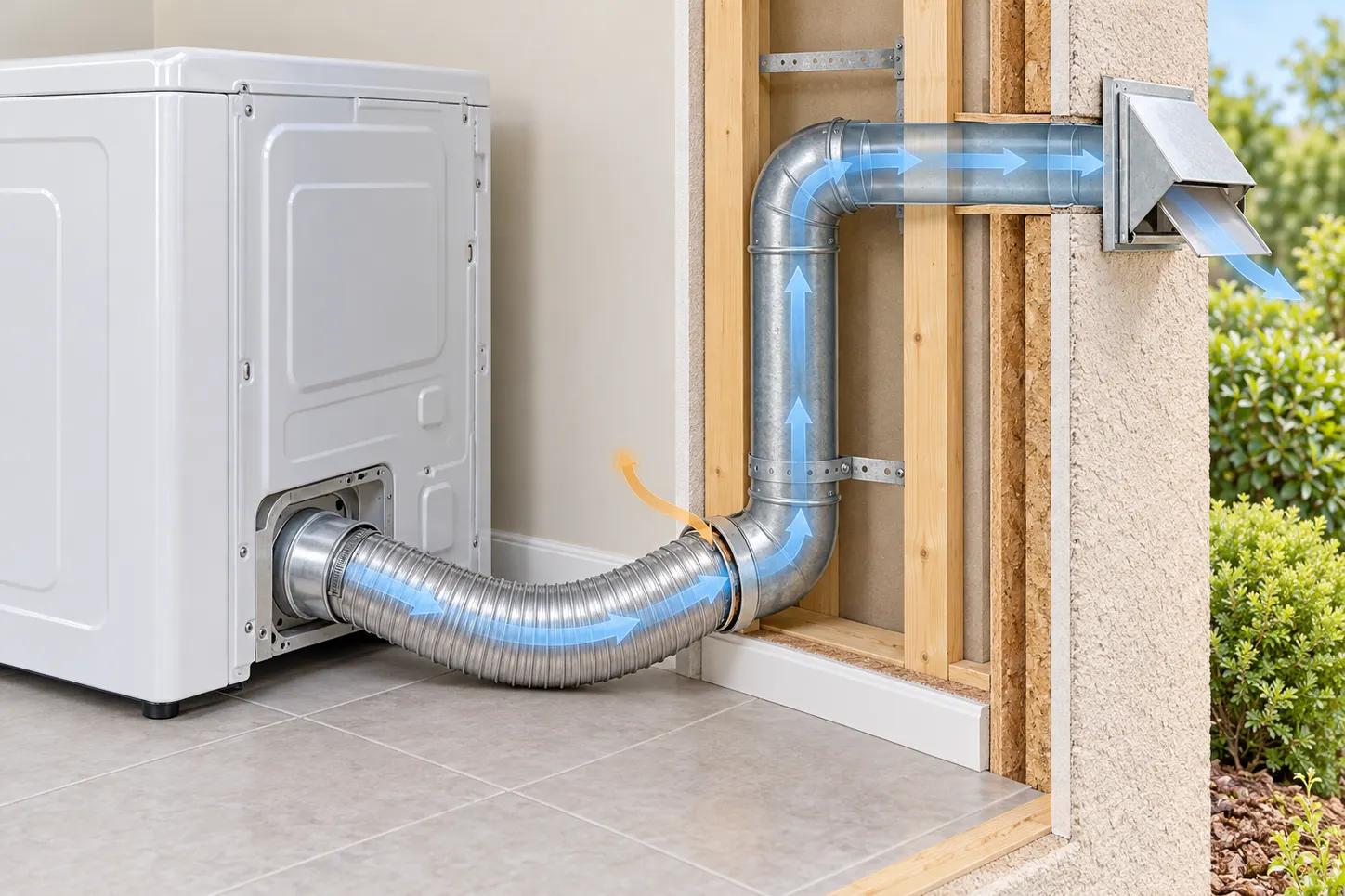
There are a number of reasons your laundry room might feel hot and humid.
Some are caused by a blockage in the airflow. Some are the result of air escaping the vent system before the air gets outside.
A Loose or Disconnected Vent
One of the simpler problems to correct is a loose connection.
The exhaust from the dryer connects to the home’s vent system by a transition duct located behind the dryer. If that connection is not fully made, some or all of the dryer’s exhaust can pass into the laundry room instead of going through the vent system.
This happens a lot after the dryer is moved. This could be to clean behind the dryer, to replace the dryer, to replace the floor, or to do any other work behind the dryer.
A partially disconnected duct may not be obvious because some air continues up the duct to the outside while some escapes into the laundry room.
If you notice some problems after the dryer was moved, you should check the connection behind the dryer.
A Damaged or Leaking Vent
A vent does not have to be completely disconnected to leak.
Damage, separation at a joint or another opening can allow exhaust air to escape and travel through the length of the vent.
Where the leak occurs is very important.
A leak behind the dryer can certainly cause the laundry room to feel very hot and humid. A leak in an attic, wall cavity, or other hidden area may be completely undetected by the homeowner.
This is one reason a persistent symptom should not be diagnosed solely by looking behind the appliance.
Professional dryer vent repair may be required when the problem is physical damage or a failing connection rather than lint buildup.
Lint Blocks Airflow
Lint gradually builds up in dryer vent systems.
When enough lint builds up, the opening for exhaust becomes smaller. The dryer has to work harder to blow air against the lint, and airflow through the system becomes less.
A restriction causes heat to build up and forces clothes to take longer to dry.
This overlaps with slow-drying clothes, but it is a separate concern.
If the main symptom is having to run the dryer again, our guide on why a dryer takes two cycles to dry covers that issue in depth.
For this issue, it is more important to determine whether restriction of airflow is keeping heat and moisture trapped where it doesn’t belong.
A Crushed or Kinked Transition Duct
The short duct behind the dryer must not be restricted to an excessive degree.
If the dryer is too close to the back wall, the transition duct becomes crushed or kinked. This severely restricts airflow.
The result is similar to a blockage, even if the rest of the vent is clean.
This illustrates why simply cleaning the vent is not a long term solution, and indicates that an exhaust path must be addressed in its entirety.
A Long or Difficult Vent Route
Not all dryers are adjacent to exterior walls.
In Los Angeles, an exterior vent for a dryer may be located a long distance from the dryer.
Turns and long routes result in more resistance than short and direct routes.
This does not necessarily mean the installation is faulty. It means that the whole route is important to diagnose airflow.
A long and obstructed route with a lot of bends can be significantly more problematic than a short and clear route.
Does Your Dryer Vent into the Laundry Room?
If moisture develops in the room only when you run the dryer, it is reasonable to be concerned if exhaust is leaking into the room.
To start, you do not need to disassemble the system.
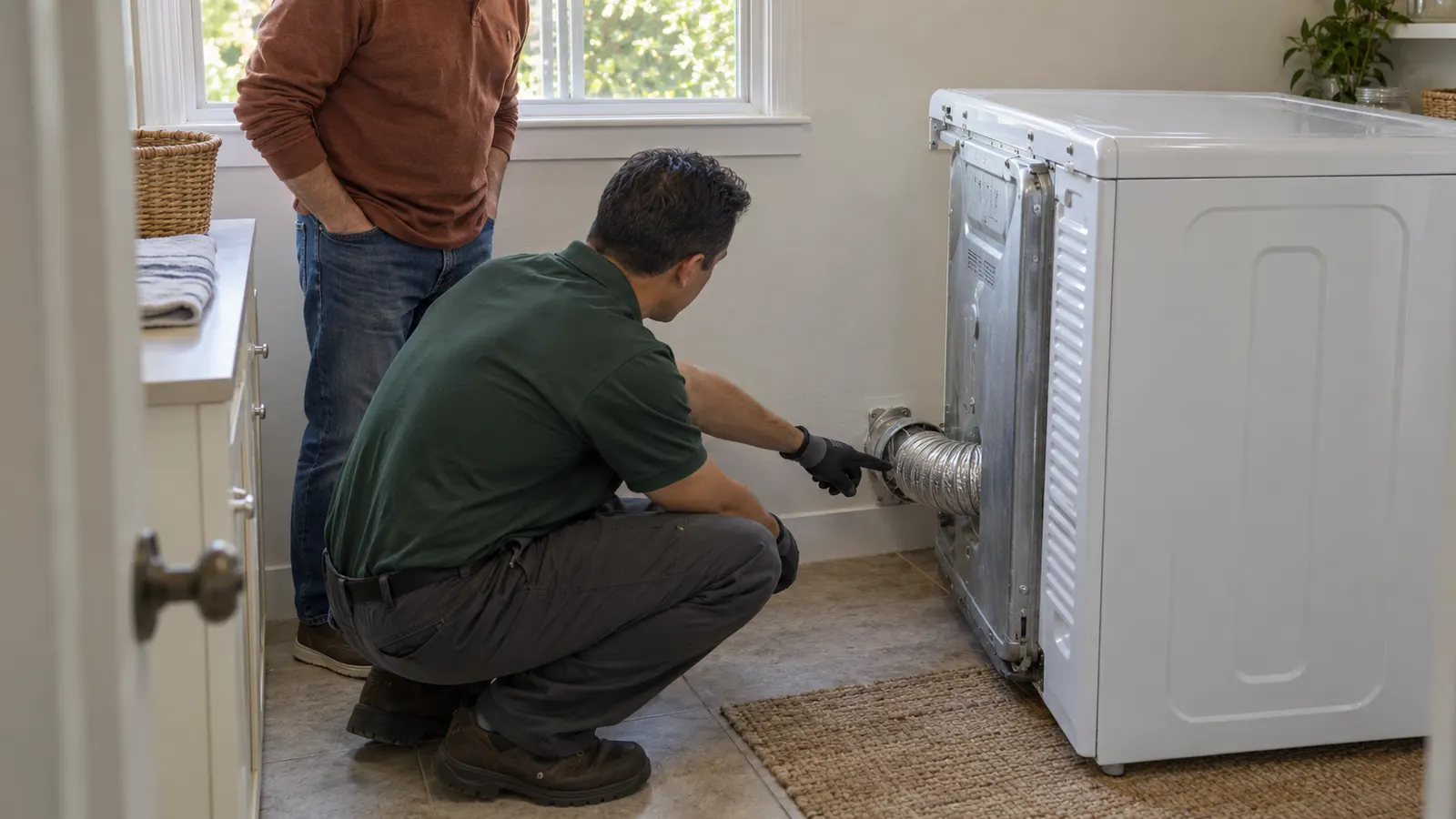
Check the area behind the dryer to see if the transition duct is connected at the ends, if it is crushed, or if it is otherwise damaged.
Do not reach into moving equipment or move a heavy appliance into an unsafe position.
Observe the room and focus your attention on the hot components.
Do you feel warm air behind the machine? Does the room quickly become humid? Does the operation of the machine seem different from before?
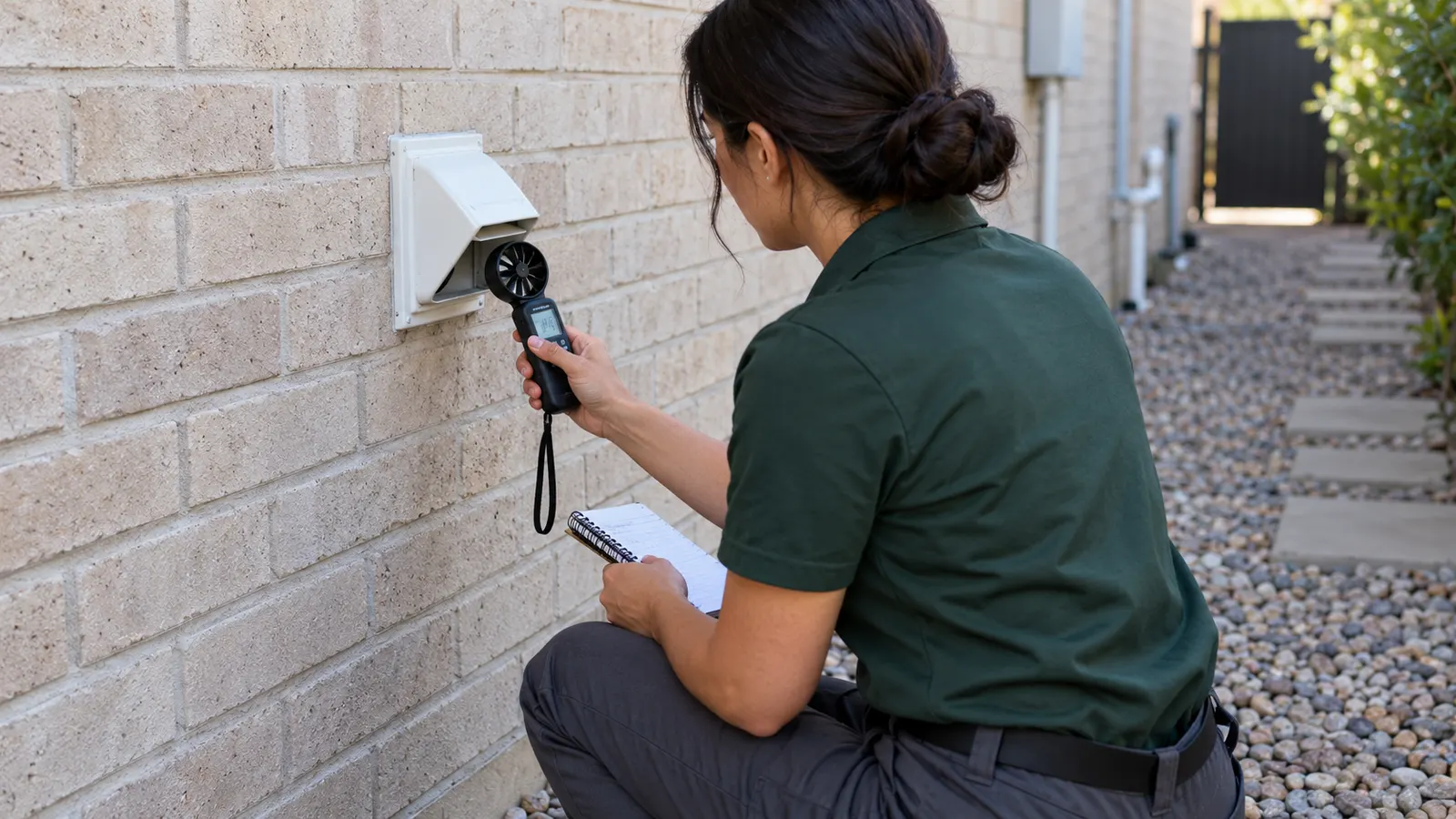
Another clue may be the exterior vent termination. Check if the exterior flap opens and airflow is present if it is safe to do so while the dryer is in operation.
A weak exterior flow is not enough to pinpoint the issue, since a blockage, crushed duct, excessively long run, damaged duct, or appliance issue can all affect performance.
Flow weakness can be one symptom of many.
Why Indoor Dryer Moisture Should Not Be Ignored
The moisture removed from laundry has to be removed from the environment somehow, and if the exhaust air is escaping into the home, the moisture is being released there, instead of being properly vented.
Over time, excess moisture raises indoor humidity, makes the room uncomfortable, and contributes to surface moisture.
The EPA suggests controlling interior moisture as a part of its initiative to stop the growth of mold, but that doesn’t mean that every dryer vent leak results in mold growth, or that a humid laundry environment has mold growth.
It means unwanted moisture should not be allowed to remain.
A diagnosis of a dryer vent problem is highly recommended if condensation, moisture stains, or a musty odor is present in the laundry area.
Hot Laundry Room vs. Slow-Drying Clothes
The symptoms of these two problems can overlap.
Long dryer cycles can result from an airflow restriction somewhere in the system.
The other question that arises is, does the exhaust air escape through the room?
If both symptoms present together, it is quite likely that the vent is restricted or damaged.
When clothes dry, but the room becomes humid, it could mean a loose connection or leak in the vent.
This helps avoid assuming every dryer complaint needs the same service.
Do You Need Dryer Vent Cleaning or Dryer Vent Repair?
This is perhaps one of the most important distinctions to get right.
Dryer vent cleaning focuses on the material that is blocked and preventing the free flow of air through the vent (like an excessive buildup of lint or something obstructing the flow of air).
Dryer vent repair addresses a physical problem with the vent (like a disconnected section, a broken duct, a poor connection, or a crushed exhaust path).
Some systems need one.
Some systems need the other.
For example, cleaning a vent cannot reconnect a duct that is disconnected. Repairing a loose connection cannot remove built up lint that is blocked farther along the flow.
The symptom may look similar from the laundry room, so the service to be provided must be diagnosed before assuming the service to be carried out.
Safe Checks Homeowners Can Make
Some checks require no removal of walls or vent components.
Clean the Lint Screen
Clean the lint screen as per the manufacturer of the appliance.
A loaded lint screen may affect the performance of the dryer, but a lint screen cannot replace the need to check the vent system when other symptoms are present.
Look Behind the Dryer
Check the transition duct (if you can do it without moving the dryer in a potentially unsafe manner).
Check for a disconnection, damage, excessive bending, or any other visible problem.
Exterior Vent Observations
If the termination can be accessed from ground level, check the vent during a drying cycle.
The flap on the exterior vent should be designed to open to allow the exhaust to be released from the house.
Do not climb onto the roof to check a roof termination.
Note Any Recent Changes
Changes can provide useful information.
Was the laundry room recently hot or even stuffy? What likely caused that? Was the dryer moved? Was new equipment added? Was construction finished nearby? Did the dryer lose efficiency?
These give the technician an idea of what may be wrong.
What Not to Do
A dryer vent system is simple, but some testing can be dangerous.
- Do not disconnect the vent to let the dryer exhaust into the room as a test.
- Do not reach behind the dryer to check for leaks near hot and/or moving components.
- Do not climb on the roof to check the termination.
- And do not think just because you pushed the dryer against the wall, it is safe. The transition duct needs adequate space to remain properly installed.
If the duct is concealed by a wall, ceiling, or attic, then a professional should be consulted rather than trying to remove the duct and determine where it goes.
How a Professional Determines the Cause
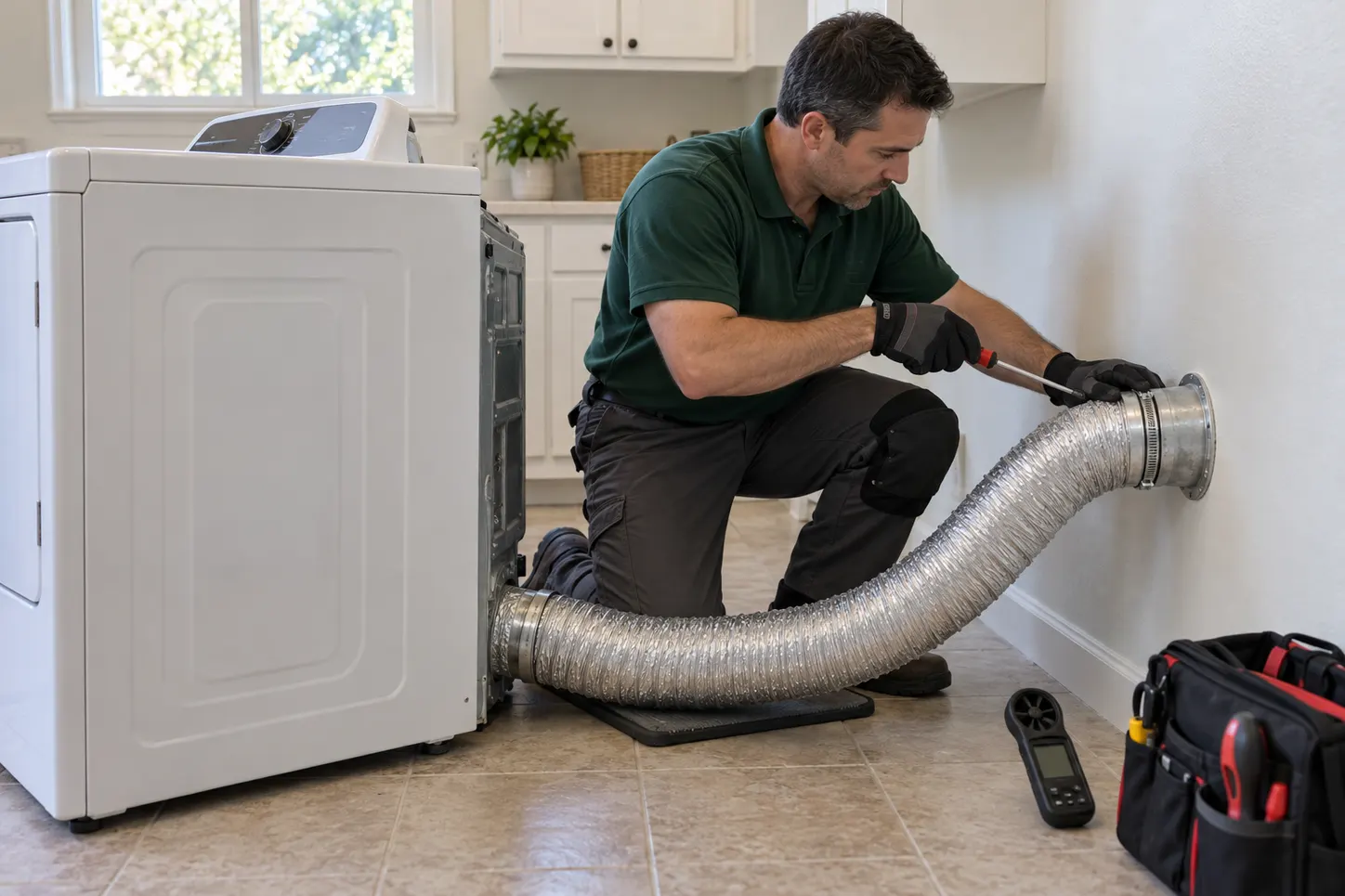
A technician must be able to diagnose whether the system has a blockage, leak, or physical damage.
The visible connection behind the dryer is one of the areas that can be checked along with airflow, exterior termination, and assessing the accessible sections of the vent route.
If the duct contains built-up lint, the obstruction will block airflow and a professional dryer vent cleaning will be necessary to restore a clear airflow path.
If the duct is broken or disconnected, dryer vent repairs will be required.
The service that is recommended should be based on what is found during the inspection.
A hot laundry room alone does not warrant a cleaning recommendation. It may be due to a broken connection.
How Dryer Vent Problems Are Corrected
The course of action is based on the results of the inspection.
Clearing an Airflow Restriction
If the accessible length of the duct shows an obstruction to airflow, the obstruction may need to be professionally removed.
The exterior termination should be checked to ensure that a clear discharge pathway is maintained for the air flow system that was cleaned.
Reconnecting a Vent
If the connection has become disconnected, it should be reconnected to the system with an appropriate method of securing the vent.
Other vent segments should also be checked to ensure that all airflow pathways are not disrupted.
Correcting a Damaged Segment
A section of the duct that is discontinuous or broken should be replaced.
The objective is to provide a continuous pathway so the dryer exhaust is able to leave the premises.
Addressing the Vent Route
If the route continuously shows problems, it may be necessary to have a technician evaluate the route to determine if new changes may be necessary.
This looks at the configuration of the exhaust system, not only lint removal.
What If the Vent Appears to Be Clear?
Not all hot laundry rooms can be attributed to the dryer vent.
In small laundry rooms, there can be natural heat buildup during operation of the appliances. Warmer room temperature can be attributed to a variety of factors: ventilation of the room, other appliances, HVAC system, and the dryer itself.
That is why the symptom must be considered in context.
If the room has started to gradually warm up, and there are no other new conditions, that is different than a room that all of a sudden becomes very hot, very humid, and damp.
Similarly, if a professional vent inspection confirms good airflow and no leakage, the next course of action is likely to assess the appliance and other conditions, and less likely to continue to clean a vent that is clear for a third time.
A good diagnosis means knowing when the duct is not the problem.
When Should You Call a Professional?
If the room begins to feel very hot and very humid during normal operation, especially if this is a new condition, it is good practice to have the dryer vent inspected.
Professional assessment is good practice if:
- a flexible connection on the duct appears to be loose;
- there is unusually weak airflow outside;
- it is taking more than usual to dry your clothes;
- any part of the duct is crushed or bent;
- you see signs of condensation;
- the vent system is enclosed and very difficult to access;
- and basic maintenance of the lint screen does not make a difference.
The goal is not to sell a cleaning. It is to find out whether dryer exhaust is making it to the exterior.
Preventing the Issue From Recurring
The following are some simple habits to practice once the issue is resolved to promote the dryer’s airflow.
Clean the dryer lint filter as suggested, do not push the dryer so far back that you compress the transition duct, monitor changes in drying efficiency, and changes in room conditions.
Professional maintenance may need to be scheduled more frequently depending on how much and how fast lint accumulates, the length and design of the vent, and how the dryer is used.
Our dryer vent cleaning frequency guide may be used to help you decide when you should have your dryer vents checked and cleaned.
The best habit is noticing a change early.
A dryer that acts differently is a dryer that is trying to tell you something.
Get the Dryer Vent Checked Instead of Guessing
If the laundry room starts to become humid and hot while the dryer is in use then it may mean that the exhaust air is not getting out to the outside of the house.
This may be caused by a build up of lint, crushing of the transition duct, a disconnected duct, a broken vent, or some other obstruction to airflow.
Obviously, each of those has its own solution and most of those require an inspection to determine the reason.
SoCal Green Air Duct & Chimney will inspect the dryer vent system for airflow loss and can recommend a cleaning or repair and determine if something else is needed.
Schedule a Dryer Vent Inspection →
Frequently Asked Questions
Why does my laundry room get hot when the dryer runs?
Some warmth is normal in a small room. Excessive heat can indicate restricted airflow or warm dryer exhaust that is escaping from a loose or damaged vent connection. If the change is significant or new, the vent system should be checked.
Why does my laundry room become humid when I use the dryer?
A dryer removes moisture from clothing and should vent that moist air outdoors. If the room becomes noticeably humid, exhaust may be leaking into the room or struggling to move through the vent system.
How do I know if my dryer is venting into the room?
Unusually warm air behind the dryer, rapid humidity increases while the dryer operates, and weak airflow at an accessible exterior termination can all be signs that the dryer is venting into the room. These are signs but not a definite diagnosis.
Can a clogged dryer vent make the laundry room hot?
Yes. Restricted airflow can lead to excessive heat around the dryer and also prolong the drying time. However loose or damaged vents can also lead to similar room temperature symptoms, so the diagnosis should be made before a service is chosen.
Does a hot laundry room mean I need dryer vent cleaning?
Not necessarily. Cleaning should be done when lint or other obstructions are found in the vent. However, if the vent is disconnected, crushed, leaking, or damaged, repair is the more appropriate choice.
Can leaking dryer vents be an issue?
Leaking dryer vents can bring hot, moist air into your space. Over time, that moisture can build up and create conditions that favor mold growth.
Can I check my own dryer vent?
You can check the duct nearest to the dryer yourself, and check an exterior vent from ground level. Avoid checking spots that require tools or climbing.
What should I do if dryer vent cleaning is not useful?
If the vent was cleaned and the laundry room still feels hot or moist, check the integrity of the ducts, search for obstructions, and check the appliance and connections.
Final Thoughts
A dryer should remove moisture, while also heating the air.
If the laundry room is hot, stuffy or humid after you run the dryer, a blockage could be slowing airflow. It could also be a crushed duct, a disconnected connection, a leak, or an appliance issue.
A leak or damaged section calls for repair. A lint blockage calls for cleaning. Find the cause first, then choose the service.