Whole-Home Air Purification System Installation
Whole Home Air Purification System Los Angeles
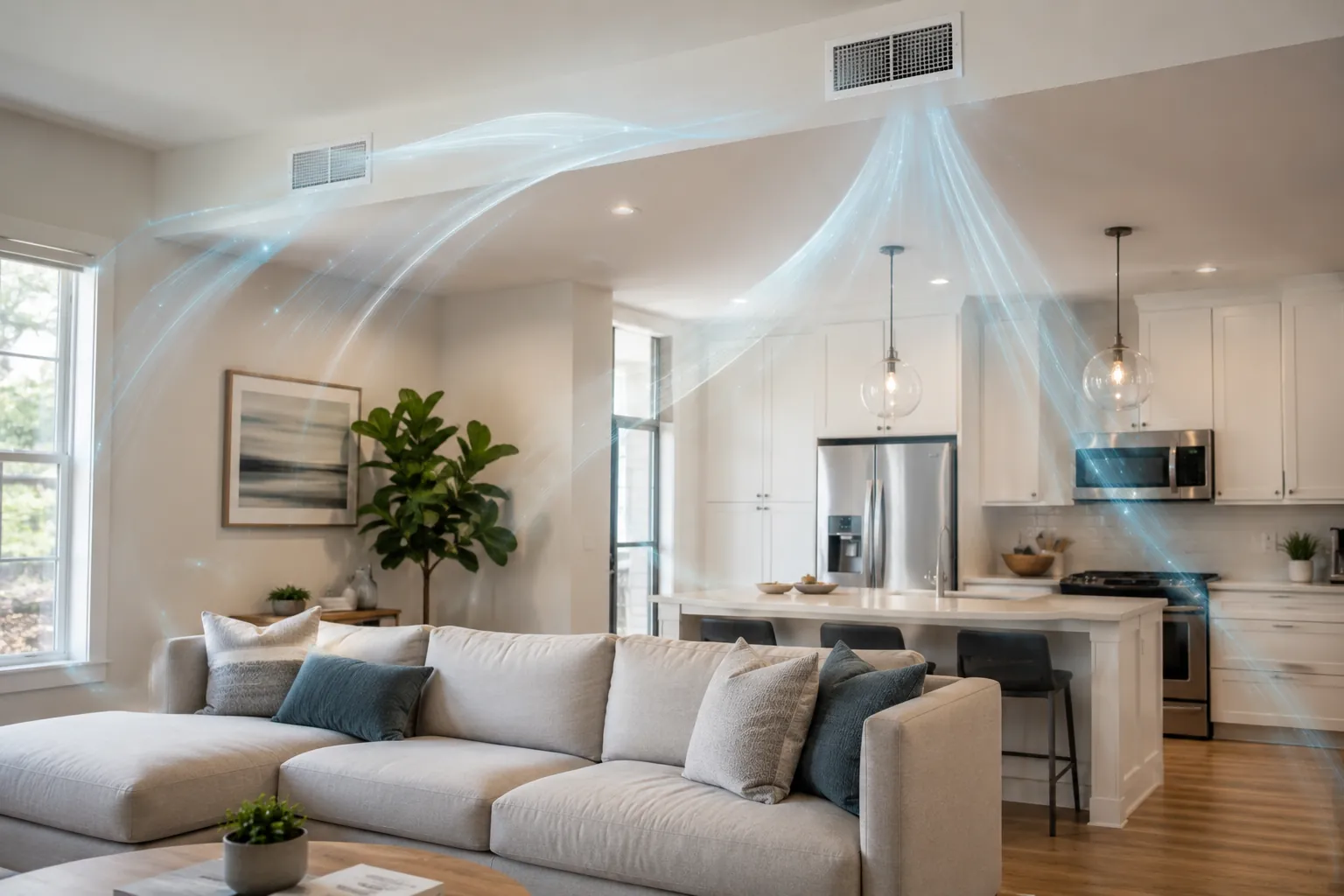
A portable air purifier cleans the room it sits in. A whole home air purification system cleans every room continuously by integrating directly with the HVAC system that already moves air throughout your home. Every time your heating or cooling runs, contaminated air is pulled through the purification system before it's redistributed. Allergens, wildfire smoke particles, VOCs, mold spores, and biological contaminants are captured or neutralized at the system level not room by room, not when you remember to turn it on. Our certified technicians assess your home's HVAC configuration, select the correct purification technology for your specific air quality concerns, and install the system in a single visit. Flat-rate pricing. Same-day scheduling across Los Angeles.
The Problem
Why Portable Purifiers and Standard HVAC Filters Fall Short in Los Angeles Homes
A standard HVAC filter the one-inch flat filter most Los Angeles homes use is designed to protect the HVAC equipment from large debris, not to improve the air quality of the people living in the home. It captures particles above 10 microns reliably. Below that threshold, including the PM2.5 particles from wildfire smoke, the sub-micron mold spores that cause allergic sensitization, and the ultrafine combustion particles from traffic and cooking, it provides minimal protection. Portable air purifiers address this gap for the specific room they're placed in but Los Angeles homes during wildfire smoke events, high-pollen periods, and the marine layer months need air treatment in every room simultaneously, operating continuously, without depending on household members to manage multiple devices. A whole-home air purification system solves this at the HVAC level treating every cubic foot of air the system distributes, to every room it serves, every time it runs.
- ⚠ Standard HVAC filters (MERV 1 to 4) capture large debris only not allergens, smoke particles, or VOCs
- ⚠ Portable units treat one room at a time leave bedrooms, hallways, and secondary rooms unprotected
- ⚠ Wildfire smoke infiltration affects the entire home simultaneously requires whole-home response
- ⚠ California's Title 24 sealed buildings trap indoor-generated VOCs and CO2 without continuous filtration
- ⚠ HVAC systems running year-round in Los Angeles distribute whatever is in the ductwork to every room
- ⚠ Pet dander, dust mite debris, and mold spores recirculate through unfiltered HVAC systems continuously
The Solution
HVAC-Integrated Purification The Right Technology Matched to Your Air Quality Profile
A whole-home air purification system integrates directly into the existing HVAC ductwork either at the air handler or in the return duct so that every air cycle passes through the purification system before being redistributed. The technology installed depends on your home's specific air quality concerns: high-efficiency media filtration for particle removal, UV-C germicidal irradiation for biological contaminant inactivation, activated carbon for VOC and odor removal, or a hybrid system combining multiple technologies. Our technicians assess your HVAC configuration, your home's contaminant profile, and your household's health priorities before recommending any system and provide a written installation estimate before any ductwork is modified.
Get Free Estimate →Benefits
Why Los Angeles Homeowners Choose Whole-Home Purification
Every Room Protected Continuously
Unlike portable units that require manual placement and operation, an HVAC-integrated system treats the air in every room the system serves automatically, every time the heating or cooling runs. No room is left unprotected.
Built for Los Angeles's Specific Air Quality Challenges
Wildfire smoke, marine layer humidity, traffic VOCs, and high pollen counts are not seasonal inconveniences in LA they are year-round variables. A permanent whole-home air purification system responds to all of them continuously without any intervention.
No Floor Space, No Noise, No Management
HVAC-integrated systems operate silently within the existing ductwork. No devices to move between rooms, no filters to track across multiple units, no noise in the bedroom at night. The system works when the HVAC runs which in Los Angeles is most of the year.
Protects the HVAC System as Well as the Occupants
Higher-efficiency filtration reduces the particulate load on HVAC components the evaporator coil, blower motor, and ductwork interior. A cleaner system runs more efficiently, requires less maintenance, and lasts longer.
Our Process
What to Expect, Step by Step
Home & HVAC Assessment Air Quality Profile First
Before recommending any system, we assess the home's specific air quality concerns existing HVAC configuration, filter slot size, duct layout, household health priorities (allergies, asthma, wildfire smoke sensitivity), and any known contaminant sources like pets, recent renovation, or a gas fireplace. We measure current HVAC airflow to confirm the existing system can support the upgrade without pressure drop problems. The right purification technology is determined by the air quality profile not by what's most profitable to install.
System Selection & Written Installation Estimate
Based on the assessment, we recommend the purification technology or combination of technologies matched to your home's specific needs. We explain what each technology addresses, what it doesn't, and what the installation involves before quoting a price. You receive a written estimate with the specific system, installation scope, and cost before any work begins.
Professional HVAC Integration
The purification system is installed into the return duct or at the air handler the point in the system where air passes through before being heated or cooled and redistributed. Duct modifications are made with metal fittings and properly sealed connections. Electrical connections for UV or electronic systems are wired to the HVAC control board where applicable. The existing system is tested for airflow balance before we leave.
System Commissioning, Filter Documentation & Maintenance Schedule
After installation, we commission the system confirming correct airflow through the purification media, proper UV lamp operation if applicable, and system integration with the HVAC control. You receive written documentation of the system specifications, installation date, filter type and replacement schedule, and UV lamp replacement interval. The maintenance schedule is specific to your installed system not a generic recommendation.
What It Means
Whole-Home Air Purification Understanding the Technologies and Choosing the Right One
A whole home air purification system is not a single product it's a category of HVAC-integrated solutions, each using a different mechanism to address a different range of airborne contaminants. Choosing the correct technology requires understanding what each one captures, what it doesn't, and how it performs in the specific conditions of your home. No single technology addresses all contaminant categories equally well and the marketing language around "99.9% effective" claims often applies to specific test conditions that don't reflect real-world HVAC operation. Understanding the four core technologies makes it possible to select a system that actually addresses your home's specific air quality concerns.
High-efficiency media filtration MERV 13 through MERV 16 rated filters installed in a dedicated media cabinet is the foundation technology for whole-home air purification. MERV 16 captures 95% or more of particles in the 0.3 to 1 micron range, including PM2.5 from wildfire smoke, fine pollen, and mold spores. This technology is purely mechanical it does not generate ozone or any byproduct, it does not require electrical power, and it operates passively on every HVAC cycle. The limitation is particle size: MERV filters do not capture VOCs, gases, or biological contaminants below the filter's rated particle capture range. For Los Angeles homes where wildfire smoke PM2.5 and allergen exposure are the primary concerns, a MERV 16 media cabinet is often the most cost-effective and reliable first technology to install.
UV-C germicidal irradiation systems install UV lamps within the HVAC ductwork typically at the air handler, near the evaporator coil to inactivate biological contaminants passing through the air stream. Mold, bacteria, and certain viruses are disrupted at the cellular level by UV-C wavelength radiation. This technology addresses the biological contaminant category that mechanical filters capture but do not neutralize a filter that captures a live mold spore has stopped it from circulating further, but a UV lamp inactivates it. For Los Angeles homes with persistent mold issues in the ductwork or evaporator coil, or for households with immunocompromised members, UV germicidal systems provide a layer of biological protection that media filtration alone doesn't achieve. The critical selection criterion is lamp output and placement geometry a UV lamp that doesn't expose passing air to adequate UV-C dosage provides minimal benefit.
Activated carbon oxidation systems address the contaminant category that neither media filters nor UV lamps handle: VOCs and gases. Activated carbon media adsorbs volatile organic compounds formaldehyde, benzene, toluene, and cooking odors by chemical bonding at the carbon surface. This is the technology required for homes where renovation off-gassing, pet odors, or cooking smoke are the primary concerns. In Los Angeles, activated carbon is particularly relevant for homes near major freeways properties along the I-405, I-10, and I-5 corridors where traffic-generated VOCs infiltrate building envelopes and for homes with gas cooking appliances that generate nitrogen dioxide and combustion-related VOCs. Carbon media requires periodic replacement as its adsorption capacity is consumed unlike HEPA-type filters, a saturated carbon media cannot be cleaned and must be replaced.
Warning Signs
Signs Your Home Needs Whole-Home Air Purification
Tap any sign to learn what it means and what to do next.
! Indoor allergy symptoms that don't improve with medication ⌄
When allergy medications provide partial relief but symptoms persist indoors particularly sneezing, eye irritation, and congestion that are consistently worse at home than outdoors the HVAC system is likely recirculating the allergens that are triggering responses. A whole-home air purification system removes allergens from the air distribution system at the source.
! Wildfire smoke odor or PM2.5 entering the home during smoke events ⌄
If wildfire smoke infiltrates your home during regional fire events detectable by smell or visible haze indoors your current filtration is not capturing the fine particles and VOCs the smoke carries. MERV 16 whole-home filtration dramatically reduces indoor smoke particle concentration during active events without requiring all windows and HVAC vents to be manually managed.
! Persistent pet odors that return between cleaning cycles ⌄
Pet dander and associated odors that return quickly after cleaning are circulating through the HVAC system and being redistributed on every air cycle. Activated carbon combined with high-efficiency particulate filtration addresses both the particle (dander) and the gaseous (odor) components simultaneously at the system level rather than room by room.
! Household members with diagnosed asthma or respiratory conditions ⌄
Asthma and chronic respiratory conditions are directly affected by indoor air quality particularly PM2.5, mold spores, and allergen concentrations. A whole-home air purification system reduces the total indoor allergen and particulate load continuously, reducing the frequency and severity of trigger events for sensitive household members.
! Recent renovation or new furniture chemical smell in the home ⌄
Formaldehyde and VOC off-gassing from new flooring, cabinetry, furniture, and paint reaches its highest concentration in the first six to twelve months after installation. An activated carbon whole-home system reduces VOC concentration during the peak off-gassing period protecting household members during the phase when chemical exposure is highest.
! Visible dust accumulating quickly on surfaces after cleaning ⌄
Rapid re-accumulation of dust on surfaces after cleaning within two or three days is evidence that the HVAC system is distributing particulate matter throughout the home on every cycle. A high-efficiency whole-home media filter dramatically reduces the particle load in the distributed air, resulting in measurably less surface dust accumulation.
Deep Dive
Everything You Should Know About Whole-Home Air Purification
Warning Signs
The Conditions That Mean Portable Air Purifiers Are No Longer Enough
Portable air purifiers are a reasonable starting point for localized air quality concerns a bedroom with a pet, a home office with new furniture, or a single room with known mold issues. They become inadequate when the air quality problem is whole-home in scope: wildfire smoke infiltrating through every exterior surface, an allergen load distributed through a central HVAC system, or VOC off-gassing from materials installed throughout the home. At that point, the number of portable units required to achieve meaningful whole-home air treatment becomes impractical both in cost and in management overhead. A single whole-home air purification system installed at the HVAC level treats the same total air volume at a lower total system cost, with no ongoing management, no room-by-room deployment decisions, and no dependence on household members remembering to operate individual units. The transition point when portable units are no longer sufficient and a whole-home system is the appropriate solution is almost always a home where air quality challenges are present year-round, not seasonally. In Los Angeles, that describes most households.
Key Points
- ✓ Year-round wildfire smoke exposure requiring continuous PM2.5 filtration
- ✓ Household members with asthma, allergies, or respiratory conditions
- ✓ HVAC system distributing allergens, pet dander, or mold spores to every room
- ✓ Renovation or new construction off-gassing requiring VOC removal across all spaces
- ✓ Persistent odors (pets, cooking, smoke) that return between cleaning cycles
- ✓ Visible dust re-accumulation confirming HVAC-distributed particulate load
Benefits
The Full Case for HVAC-Integrated Whole-Home Purification Over Portable Solutions
The comparison between whole-home and portable air purification comes down to coverage, consistency, and cumulative cost. A high-quality portable HEPA unit for a bedroom costs $200 to $600 and treats approximately 300 to 500 square feet effectively. A typical Los Angeles home has four to six primary occupied spaces. Equipping each with a capable portable unit and replacing filters across all of them annually costs more than a professionally installed HVAC-integrated system over a two-to-three year period and still doesn't achieve the continuous, whole-home coverage that an integrated system provides. Beyond the economics, the performance difference is meaningful: a portable unit in the living room does not treat the air in the hallway, the guest room, or the master bedroom while a household member is sleeping but the HVAC system distributes air to all of them simultaneously. The whole home air purification system operates on every distribution cycle regardless of time of day, room occupancy, or household management. For Los Angeles homeowners who need continuous air protection against wildfire smoke, year-round allergens, and HVAC-distributed particulates that consistency is the central value proposition.
Key Points
- ✓ Single installation treats all rooms the HVAC serves simultaneously and continuously
- ✓ Lower total cost than equivalent portable unit coverage over a 2 to 3 year period
- ✓ No operating noise in bedrooms integrated with existing HVAC sound envelope
- ✓ No floor space occupied installed within existing ductwork infrastructure
- ✓ Reduces particulate load on HVAC components extends equipment service life
- ✓ Upgradeable UV and carbon stages can be added to existing media installations
Maintenance
What Whole-Home System Maintenance Actually Involves
The maintenance requirements of an HVAC-integrated whole-home air purification system vary by technology type but all are significantly simpler than managing multiple portable units across a home. High-efficiency media filters in a dedicated cabinet typically require replacement every six to twelve months, depending on the home's particulate load and the filter's rated dust-holding capacity. This is a single annual or biannual task rather than the monthly filter replacement required by standard flat HVAC filters at the same filtration efficiency. In Los Angeles, where wildfire smoke events and high-pollen periods can load filters faster than average, monitoring filter pressure drop or scheduling a check at the six-month mark during fire season is the most appropriate maintenance approach rather than a fixed calendar interval. UV-C germicidal lamp systems require annual lamp replacement regardless of visible condition UV-C output degrades with operating hours even when the lamp appears to be functioning. Activated carbon media replacement is determined by odor breakthrough: when the carbon's adsorption capacity is consumed, VOC odors return. Most carbon installations in LA homes need replacement every twelve to eighteen months, depending on VOC source load. Every system we install includes a written maintenance schedule specific to the installed technology and your home's operating conditions.
Key Points
- ✓ MERV 16 media filter replacement every 6 to 12 months monitor during wildfire season
- ✓ UV-C germicidal lamp replacement annually output degrades with hours regardless of appearance
- ✓ Activated carbon media replacement when odor breakthrough occurs typically 12 to 18 months in LA
- ✓ Annual HVAC system inspection confirms purification system is correctly integrated and sealed
- ✓ Filter housing seal inspection ensures no bypass airflow around the purification media
- ✓ Keep written installation record includes filter specifications, lamp model, and replacement schedule
What's Included
A Complete Installation System Specified, Installed & Commissioned in One Visit
Every whole-home air purification installation includes pre-installation HVAC assessment, system selection matched to your air quality profile, professional ductwork integration, and post-installation commissioning. One flat rate confirmed before any ductwork is modified.
- ✓ Pre-installation HVAC assessment airflow, filter slot, duct configuration
- ✓ Air quality profile review contaminants of concern, household health priorities
- ✓ System technology selection and written recommendation
- ✓ High-efficiency media cabinet installation (MERV 13 to 16) particle filtration
- ✓ UV-C germicidal lamp installation biological contaminant inactivation
- ✓ Activated carbon media installation VOC and odor removal
- ✓ Hybrid multi-technology systems combined particle, biological, and VOC treatment
- ✓ Ductwork modification and sealing all connections sealed against bypass airflow
- ✓ Post-installation airflow verification system balance confirmed
- ✓ Written documentation system specs, maintenance schedule, filter and lamp replacement guide
15+ Years Serving Southern California Homeowners
Our Promise
You'll Always Know What You're Paying Before We Start
No system recommended before we've assessed your HVAC and your air quality profile. No installation begun before you've seen the written scope and price. Every whole-home air purification installation is backed by our workmanship guarantee and documented with written system specifications and a maintenance schedule before we leave.
Certified Technicians
Every installation is performed by a certified, insured technician trained in HVAC integration, ductwork modification, and air purification system commissioning not a general handyman with a media cabinet kit.
Technology-Matched Recommendations
We recommend the purification technology that addresses your specific air quality concerns not the most expensive option available. Media filtration, UV germicidal, activated carbon, and hybrid configurations are all available matched to what your home actually needs.
Same-Day Scheduling
Installation appointments available across Los Angeles, Pasadena, Burbank, Glendale, Santa Monica, and the San Fernando Valley with priority scheduling during wildfire smoke events and for households with medically sensitive occupants.
Workmanship Guarantee
Every installation is backed by our guarantee. If the system integration fails to perform correctly after installation, we return to resolve it at no additional charge.
FAQs
Quick answers from our techs.
Still have a question? Call us, we answer the phone, day or night.
Call (888) 280-2285 →What is the difference between a whole home air purification system and a portable air purifier?
A whole-home system integrates directly into the HVAC ductwork and treats all air distributed to every room on every HVAC cycle passively and continuously. A portable unit treats the specific room it's placed in when it's operating. For whole-home air quality challenges wildfire smoke infiltration, allergen distribution through HVAC, or VOC off-gassing from materials throughout the home a portable unit addresses the symptom in one room. A whole-home system addresses the cause in every room simultaneously.
Will a whole-home air purification system reduce my exposure to wildfire smoke?
Yes, significantly. A MERV 16 media cabinet installed in the HVAC return duct reduces indoor PM2.5 concentration during wildfire smoke events by approximately 80 to 90% compared to a standard HVAC filter. During active smoke events when windows must remain closed, the HVAC system with whole-home filtration becomes the primary air quality protection mechanism for the entire home.
Will a high-efficiency HVAC filter damage my air conditioning system?
If properly sized and installed, no. The critical factor is matching the filter's pressure drop characteristics to your HVAC system's rated airflow capacity. A filter with too high a pressure drop for the installed HVAC can reduce airflow, causing evaporator coil icing and blower motor strain. Our pre-installation assessment confirms your system can support the upgrade before any filter cabinet is installed and we select the appropriate MERV rating that balances filtration efficiency with airflow compatibility.
How long does installation take?
Most whole-home air purification system installations take two to four hours for a standard single-zone HVAC system. Media cabinet installations at the simple end of the range are completed in one to two hours. Combined media plus UV or carbon systems, or installations with non-standard duct configurations, may take up to four hours. We confirm the timeline after the pre-installation assessment.
Does a whole-home system replace the need for regular air duct cleaning?
No, the two services address different problems. Air duct cleaning removes accumulated debris, mold, and contaminants from the interior surfaces of existing ductwork. A whole-home air purification system filters the air passing through clean ductwork going forward. Both are needed in sequence: duct cleaning first establishes a clean distribution system, and whole-home filtration prevents the same contamination from re-accumulating at the same rate.
Service Areas
Air Duct & Chimney Services Across Los Angeles County
SoCal Green Air Duct & Chimney provides air duct cleaning, chimney sweeping, dryer vent cleaning, and indoor air quality services throughout Los Angeles County. Our certified technicians serve residential and commercial properties across these communities and beyond.
Ready to Upgrade Every Room's Air Quality Permanently?
Book a whole-home air purification assessment today. HVAC review, technology recommendation, written installation estimate all before any work begins. Most appointments across Los Angeles and Southern California are available within 48 hours.