Professional Chimney Leak Repair Service
Chimney Leak Repair Service Los Angeles
A water stain on the ceiling near your fireplace looks like a simple leak. It rarely is. Water entering through a chimney travels along roof decking, down wall framing, and across ceiling cavities before appearing as a stain, often feet away from where it actually entered. Patching the stain doesn't fix the leak. Identifying the entry point does. Our CSIA-certified technicians perform a systematic source diagnosis before recommending any chimney leak repair in Los Angeles, so the repair addresses where the water is getting in, not just where it shows up. Written estimates. Flat-rate pricing. Same-day scheduling.
The Problem
Why Chimney Leaks Are Harder to Diagnose Than They Look
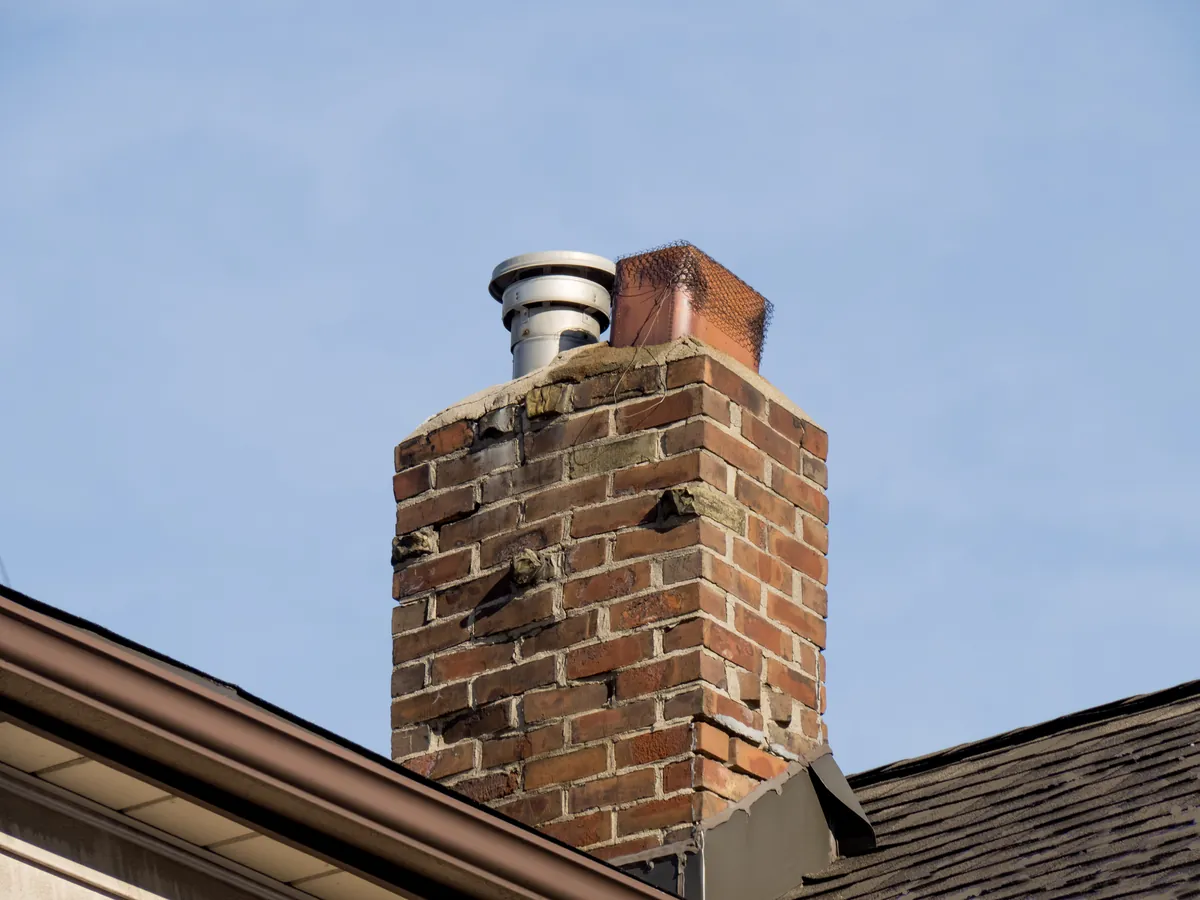
Water follows the path of least resistance, and in a chimney system, that path is rarely straight down. Water entering through failed flashing at the roofline can travel horizontally across roof sheathing and appear as a ceiling stain six feet from the chimney. Water entering through a cracked crown can saturate the masonry, travel down the chimney structure inside the wall, and produce a stain at ceiling level that looks like a roof leak. Water absorbed through porous masonry on the chimney's exterior face can reach the interior wall surface over multiple rain seasons with no visible exterior symptom at all. In Los Angeles, where the combination of concentrated seasonal rainfall, aging housing stock, and seismic movement creates multiple simultaneous failure conditions, a leaking chimney frequently has more than one water entry point, which means repairing only the most obvious one does not stop the leak.
- ⚠ Failed chimney flashing, the most common source of chimney-related ceiling and wall leaks
- ⚠ Cracked chimney crown, allows direct rainfall into the masonry and flue system from above
- ⚠ Porous or cracked masonry, bricks and mortar absorb rainwater and transfer it inward
- ⚠ Missing or damaged chimney cap, direct rain entry into the flue opening
- ⚠ Condensation from an oversized or unlined flue, moisture forming inside from gas appliance exhaust
- ⚠ Deteriorated mortar joints, open pathways for water penetration through the chimney structure
The Solution
Source Identification Before Repair, Every Time
A permanent chimney leak repair requires confirming the water entry point before selecting the repair method. Our technicians perform a systematic inspection of every possible source: flashing condition at the roofline, crown integrity from the roof surface, masonry absorption and mortar joint condition, chimney cap status, and the flue interior for condensation indicators. Where the source is ambiguous, common in older Los Angeles homes where multiple components have deteriorated simultaneously, we use a controlled water test to confirm which component is responsible before any repair material is applied. The result is a repair that addresses the actual source, not a repair that assumes it.
Get Free Estimate →Benefits
Why Homeowners Choose This Service
Source Confirmed Before Work Begins
Most chimney leak repairs fail because they address the visible symptom rather than the confirmed source. We identify the entry point first, so the repair holds through the next rain season, not just the current one.
One Visit Covers All Entry Points
A chimney with failed flashing often has a cracked crown and deteriorated mortar joints simultaneously. Addressing all confirmed entry points in one visit prevents the second leak that appears after the first one is patched.
Stops the Downstream Damage
A leak that continues for multiple rain seasons produces mold, structural wood rot, damper rust, and liner deterioration. Stopping it at the source stops every downstream consequence from compounding further.
Written Estimate Based on Confirmed Findings
Chimney leak repair cost depends on which component failed and how severely. You receive a written estimate after source confirmation, not before we know what we're actually repairing.
Our Process
What to Expect, Step by Step
Interior Assessment, Mapping the Symptom
We begin inside: documenting the location, pattern, and extent of water staining, efflorescence, mold, or rust on the firebox, damper, and surrounding walls and ceiling. The symptom pattern, where the stain is, how it's shaped, whether it follows a seam or appears as a diffuse spread, provides the first directional indicator of where the water is entering and the path it traveled to get there.
Roof-Level & Exterior Inspection, Identifying the Source
We access the roof and inspect every possible entry point directly: flashing condition at the step and counter flashing line, crown surface integrity, chimney cap condition, and the visible masonry for cracking, spalling, and mortar joint recession. We photograph every finding. Where the source is not definitively confirmed by visual inspection alone, we perform a controlled water test, applying water to specific components in sequence while a second technician monitors the interior, to isolate which component is responsible.
Source-Matched Repair Execution
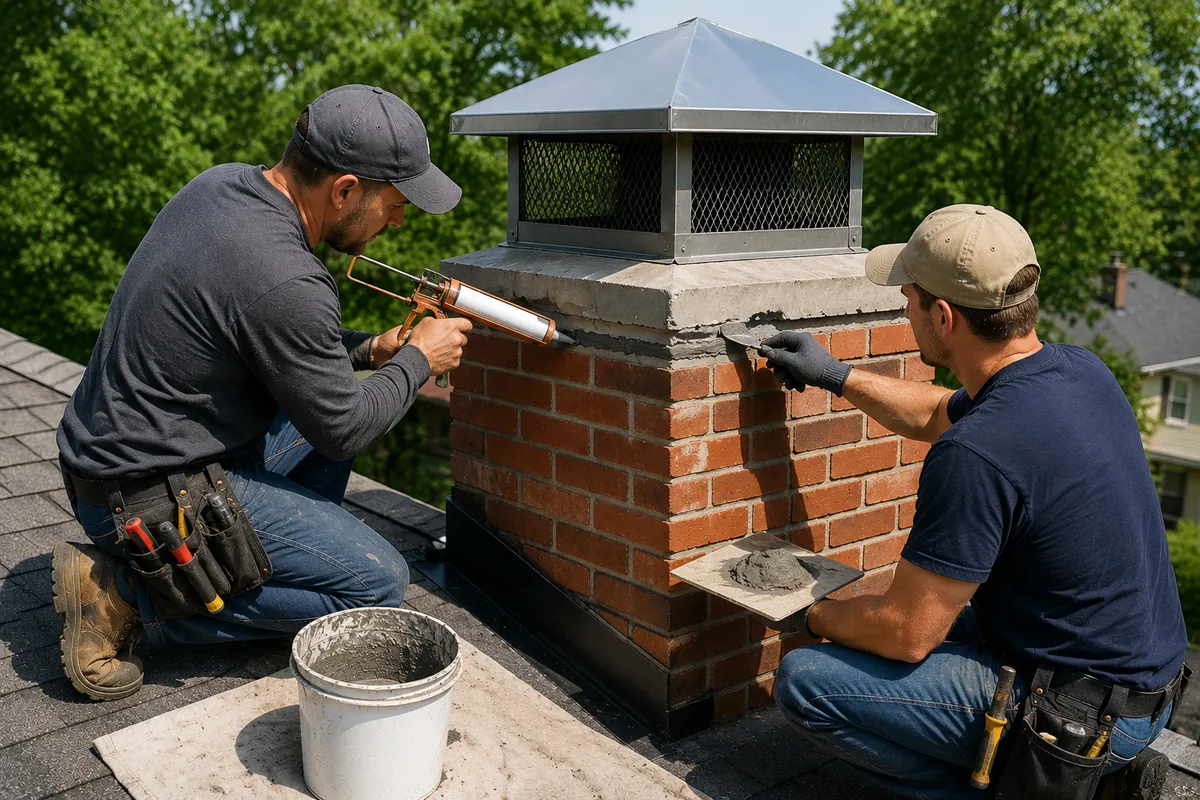
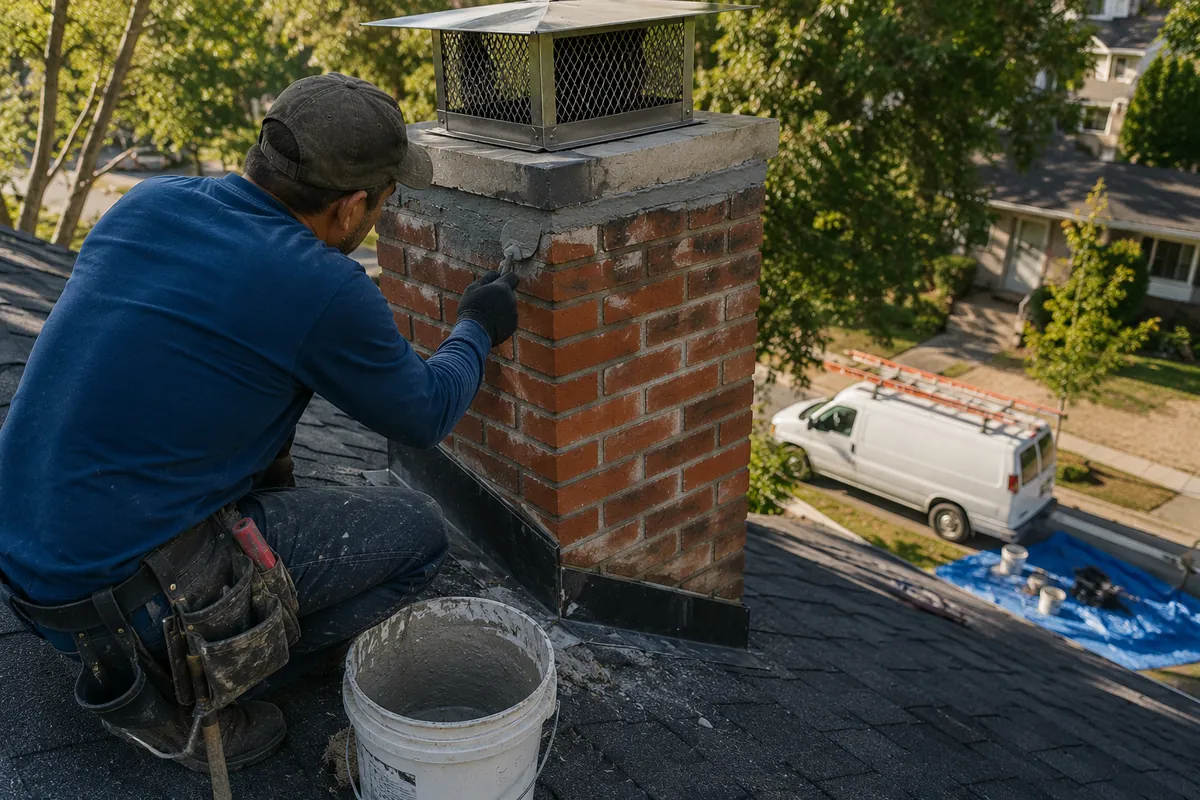
Repair method is determined by confirmed source. Flashing failure: removal of deteriorated flashing sections and installation of new step and counter flashing with elastomeric sealant. Crown failure: elastomeric coating, full resurfacing, or crown replacement matched to the damage stage. Masonry absorption: vapor-permeable masonry waterproofing sealant applied to the exterior face. Mortar joint deterioration: tuckpointing with mortar matched to the existing masonry. Cap failure: chimney cap replacement with a properly sized, pest-resistant stainless steel unit.
Post-Repair Documentation & Water Test
After repairs are complete, we perform a final water test on the repaired components to confirm the entry point is sealed. You receive a written service record documenting the confirmed source, repair type, materials used, and post-repair test result, before we leave.
What It Means
Chimney Leak Repair, Why Source Diagnosis Determines Whether the Fix Lasts
A chimney leak has three separate locations: the entry point where water penetrates, the travel path it follows, and the visible endpoint where it shows up as a stain. Most repairs target the endpoint but it reappears after every rain until the actual entry point is sealed.
Flashing failure is the most common source. When counter flashing pulls away from deteriorated mortar accelerated by thermal cycling and minor seismic movement water runs between the chimney and roof, often surfacing as a ceiling stain far from the chimney. The fix: remove the flashing, repoint the joint, reseal with a movement-rated elastomeric sealant.
A cracked crown is the second most common source, and the one most often mistaken for flashing failure. Crown water enters from the top and saturates the masonry from above, producing a more diffuse stain lower on the wall. Telling the two apart takes direct inspection and a confirmed crown leak is resolved through proper chimney crown repair.
Masonry absorption is the source most often missed: porous brick absorbs water across its whole surface with no single entry point, especially in coastal LA's marine-layer humidity. The fix is a vapor-permeable waterproofing sealant that blocks absorption while letting masonry breathe.
Warning Signs
Signs Your Chimney Has an Active Water Intrusion Problem
Tap any sign to learn what it means and what to do next.
! Water stains on the ceiling or wall near the fireplace ⌄
The most common interior symptom of a chimney leak, and the most frequently misattributed one. Water stains near the fireplace are almost always chimney-sourced, but the stain location rarely identifies the entry point. Professional source diagnosis is required before any repair is selected.
! Rust on the damper or fireplace doors ⌄
Rust on metal components inside the firebox is evidence that liquid water has been reaching the smoke chamber or firebox interior over multiple rain seasons. The source is typically a failed cap allowing direct rain entry, a cracked crown admitting water into the flue, or flashing failure allowing water to travel down the chimney interior. Rust indicates the leak has been active long enough to cause oxidation, the chimney structure has been absorbing moisture for an extended period.
! Efflorescence on the interior firebox walls or exterior masonry ⌄
White mineral deposits on firebox brick or exterior chimney masonry are left behind when water moves through masonry and evaporates at the surface. Efflorescence does not cause the leak, it's evidence of water that has already been moving through the masonry. Its location on the exterior face indicates surface absorption. Its location inside the firebox indicates water reaching the interior through the flue system or from above.
! Musty or mold smell from the fireplace ⌄
A musty odor from the firebox, particularly one that intensifies during humid weather or after rainfall, indicates moisture accumulation inside the flue system or smoke chamber. This is commonly combined with visible mold on firebox masonry. Both indicate active water intrusion that has been ongoing long enough for biological growth to establish.
! Spalling or deteriorating mortar joints in the upper chimney ⌄
Visible deterioration in the mortar joints of the upper chimney courses, recession, crumbling, or missing mortar, indicates that water has been penetrating through these joints for multiple seasons. The upper courses deteriorate first because they receive the most direct rain exposure and are closest to the crown and flashing where entry points are most common.
! Water pooling inside the firebox after rainfall ⌄
Water visible in the firebox after rain is direct evidence that rainfall is entering the flue system from above. The most common sources are a missing or damaged chimney cap allowing direct entry, or a cracked crown that has deteriorated enough to admit significant water volume rather than just saturating the masonry. Either condition requires immediate repair, water pooling in the firebox damages the damper, the firebox mortar, and the ash door hardware on every rain event.
Deep Dive
Everything You Should Know About Chimney Leaks
Warning Signs
The Warning Signs That Mean a Chimney Leak Has Already Caused Structural Damage
A chimney leak that's producing interior symptoms has almost always been active for longer than the symptom suggests. Water stains appear after water has been traveling through the structure for enough cycles to saturate the materials it passes through, typically after one to three full rain seasons of active intrusion. By that point, the damage chain has already progressed beyond the chimney itself: roof sheathing near the flashing line may have begun to rot, ceiling framing may have absorbed enough moisture to support mold growth, and the masonry below the leak source has been weakened by repeated saturation and drying. This means that a chimney leak repair in Los Angeles, even a successful one that permanently seals the entry point, does not undo the damage that's already occurred. It stops it from continuing. Any structural wood rot, mold growth, or liner deterioration that's already present requires separate remediation. Acting at the first symptom, or better, at the annual inspection before any symptom appears, is the only approach that keeps the damage chain short.
Key Points
- ✓ Water stains on ceilings or walls adjacent to the chimney
- ✓ Rust on damper, fireplace doors, or metal firebox components
- ✓ Efflorescence on interior firebox or exterior chimney masonry
- ✓ Musty odor or visible mold in the firebox or smoke chamber
- ✓ Spalling or recessed mortar joints in upper chimney courses
- ✓ Water pooling inside the firebox after rainfall
Benefits
The Full Case for Source-Confirmed Chimney Leak Repair
The financial argument for confirmed-source chimney leak repair is straightforward: a repair that doesn't stop the leak requires a second repair, plus the cost of whatever additional damage the leak caused between the first and second service visits. Industry data on chimney leak repair costs consistently shows that the most expensive outcomes are not large initial repairs, they're small initial repairs that failed because the source was incorrectly identified, followed by the downstream structural damage that continued accumulating while the problem was presumed solved. Roof sheathing rot repair costs $2,500 to $4,000. Mold remediation in ceiling and wall cavities ranges from $500 to several thousand dollars depending on extent. Flue liner replacement from moisture-related deterioration costs $900 to $3,800. None of these repairs are necessary if the chimney leak is correctly sourced and sealed at the first service visit. Source confirmation before repair isn't a premium service, it's the baseline that determines whether the repair actually works.
Key Points
- ✓ Source-confirmed repairs don't require second visits after the next rain
- ✓ Stops roof sheathing and ceiling framing rot before it requires structural remediation
- ✓ Eliminates the moisture conditions that support mold growth in wall and ceiling cavities
- ✓ Prevents damper and firebox hardware deterioration from continuing with every rain event
- ✓ Protects the flue liner from moisture-related cracking that creates CO pathway risks
- ✓ Written post-repair water test confirms the entry point is sealed, not assumed sealed
Maintenance
How to Protect Your Chimney From Water Intrusion Between Service Visits
The most effective between-service habit for chimney leak prevention in Los Angeles is a visual inspection of the exterior chimney after the first significant rainfall of each season, typically November through December. Look for new efflorescence on the masonry, any change in the crown surface visible from the roofline, and any gap that has appeared along the flashing line where the chimney meets the roof. New efflorescence indicates that a moisture pathway has opened since the last inspection. A new gap at the flashing line means counter flashing has moved, and water entered the last time it rained. Both findings warrant professional assessment before the next significant rainfall. Chimney waterproofing sealant applied to the exterior masonry every five to seven years provides the most cost-effective preventive protection against masonry absorption, the leak source that produces no discrete visible failure point until damage is already extensive. And ensuring the chimney cap is present, properly sized, and functioning correctly is the single lowest-cost intervention that prevents the most common causes of direct water entry into the flue.
Key Points
- ✓ Inspect exterior masonry for new efflorescence after the first rainfall each season
- ✓ Check the flashing line for gaps or separation from the roofline visually after heavy rain
- ✓ Ensure the chimney cap is present, undamaged, and functioning, inspect seasonally
- ✓ Apply vapor-permeable masonry waterproofing sealant every 5 to 7 years
- ✓ Address any new interior stain immediately, do not wait for the next annual service
- ✓ Schedule annual professional inspection before the rainy season begins, not after symptoms appear
What's Included
A Complete Leak Repair Service, Source Confirmed, Repair Documented
Every chimney leak repair service includes systematic source diagnosis before any repair material is applied. One flat rate confirmed after diagnosis, not before. No repair scope applied to a symptom we haven't confirmed the source of.
- ✓ Interior symptom mapping, stain location, pattern, and extent documentation
- ✓ Roof-level inspection, flashing, crown, cap, and visible masonry assessment with photography
- ✓ Controlled water test where source is ambiguous, component-by-component isolation
- ✓ Written source diagnosis and repair recommendation before work begins
- ✓ Flashing repair or replacement (chimney flashing repair Los Angeles) where confirmed
- ✓ Crown crack sealing, resurfacing, or replacement where confirmed
- ✓ Masonry waterproofing application where absorption is the confirmed source
- ✓ Tuckpointing of deteriorated mortar joints where confirmed
- ✓ Chimney cap inspection and replacement where confirmed
- ✓ Post-repair water test, confirming the source is sealed
- ✓ Written service record with confirmed source, repair type, materials, and test result
15+ Years Serving Southern California Homeowners
Our Promise
You'll Always Know What You're Paying, Before We Start
No repair estimates before we've confirmed the source. No repair scope applied to a symptom we haven't traced to its origin. You receive a written estimate after source diagnosis, based on what we actually found, photographed, and confirmed, and a post-repair water test that proves the fix worked. Every repair is backed by our workmanship guarantee.
CSIA-Certified Technicians
Every chimney leak repair is performed by a certified, insured chimney professional trained in water intrusion diagnosis and source-specific repair techniques, not a roofer who seals the most visible gap and hopes it stops.
Written Estimates After Diagnosis
Source confirmed first, price second. You see what we found, with photographs, and the full repair cost before we apply any material. What we quote is what you pay.
Same-Day Scheduling
Inspection and repair appointments available across Los Angeles, Pasadena, Burbank, Glendale, Santa Monica, and the San Fernando Valley, with priority scheduling during and after rain events when active leaks need immediate attention.
Post-Repair Water Test & Workmanship Guarantee
Every chimney leak repair includes a water test confirming the source is sealed, not assumed. Every repair is backed by our workmanship guarantee. If the same entry point leaks after our repair, we return to resolve it at no charge.
FAQs
Quick answers from our techs.
Still have a question? Call us, we answer the phone, day or night.
Call (888) 280-2285 →Why does my chimney leak only during heavy rain?
Light rainfall may not produce enough water volume to overwhelm a partial seal at the entry point, but heavy rain does. A chimney that leaks only during significant rainfall still has an active water intrusion problem at a specific entry point. The entry point is present continuously, only the rainfall intensity needed to produce visible symptoms changes. The repair requirement is the same regardless of how much rain triggers the leak.
Can chimney flashing repair in Los Angeles be done without replacing the roof shingles?
In most cases, yes. Counter flashing, the portion embedded in the chimney mortar joint, can be repaired or replaced without disturbing the roof shingles below it. Step flashing, the portion woven into the shingles, may require partial shingle removal if it has corroded through or separated. We assess which flashing components require replacement after roof-level inspection and communicate the scope before beginning any work.
How do I know if the leak is from the chimney or the roof?
The symptom location and pattern often suggest which is more likely, but not always conclusively. A stain that appears directly at the chimney-ceiling junction and is concentrated near the chimney base suggests flashing failure. A diffuse stain that spreads across the ceiling away from the chimney could be either. A professional inspection of both the chimney components and the roof surface near the chimney, combined with a controlled water test where needed, is the reliable way to confirm the source. We perform this assessment as the first step of every chimney leak repair service call.
When is the best time to clean AC ducts in Los Angeles?
Early spring is ideal before the peak cooling season so your system starts summer with clean ducts and maximum airflow. Spring also means better technician availability before the summer rush. If you miss spring, a fall cleaning after peak season addresses the full summer's accumulation and doubles as furnace duct cleaning before winter heating begins. The worst time to discover severely contaminated ducts is during a heat wave when technician availability is low and your system is working at maximum load.
How long does chimney leak repair take?
Most source diagnosis and repair visits are completed in a single day. Simple repairs, cap replacement, elastomeric crown coating, or flashing sealant application, take two to four hours including the post-repair water test. More complex repairs, full flashing replacement, crown resurfacing, or tuckpointing of multiple mortar joint courses, may require a full day or a return visit for final sealing after mortar cure time. We communicate the timeline after source confirmation and before any work begins.
Service Areas
Air Duct & Chimney Services Across Los Angeles County
SoCal Green Air Duct & Chimney provides air duct cleaning, chimney sweeping, dryer vent cleaning, and indoor air quality services throughout Los Angeles County. Our certified technicians serve residential and commercial properties across these communities and beyond.
Active Chimney Leak? Find Out Where It's Actually Coming From.
Book a professional chimney leak repair inspection today. Source diagnosis, written findings, and a confirmed repair, not a patch applied to the most visible symptom. Most appointments across Los Angeles and Southern California are available within 48 hours.