Professional Chimney Liner Repair Service
Chimney Liner Repair Service Los Angeles
The flue liner is the only barrier between the combustion process inside your chimney and the wood framing, insulation, and living spaces surrounding it. A liner with cracked clay tiles, corroded seams, or earthquake-displaced joints is no longer performing that function, it is allowing heat and combustion gases to reach materials they were never designed to contact. Our CSIA-certified technicians perform camera-confirmed liner assessment and recommend the correct repair approach for your specific liner material and damage extent, ceramic sealant application, stainless steel relining, or cast-in-place resurfacing, with chimney liner repair cost confirmed in writing before any work begins.
The Problem
Why Chimney Liners Fail, and Why the Material Determines the Failure Mode
Every chimney liner material fails differently, and the correct repair approach depends entirely on understanding which failure mode has occurred, not just that a liner is damaged. Clay tile liners, which are present in the majority of Los Angeles homes built before 1980, crack from thermal shock, moisture cycling, and seismic movement, the three forces that act simultaneously on masonry chimneys across the LA basin. Stainless steel liners corrode from acid condensation produced by high-efficiency gas appliances and from moisture penetrating through a compromised chimney cap or crown. Unlined chimneys, which the Chimney Safety Institute of America describes as representing conditions "little less than criminal", expose the surrounding masonry and wood framing to the full thermal and chemical output of combustion without any protective barrier at all. Each condition requires a different repair solution, and none can be assessed accurately without a camera inspection of the full flue interior.
- ⚠ Clay tile thermal cracking, rapid temperature change causes tile joints to fracture
- ⚠ Seismic tile displacement, earthquake movement shifts liner sections out of alignment
- ⚠ Moisture-induced tile deterioration, water cycling through cracks erodes tile surfaces from inside
- ⚠ Stainless steel corrosion, acid condensation from gas appliances degrades liner seams and welds
- ⚠ Missing liner sections, tiles collapsed or removed, leaving gaps in the thermal barrier
- ⚠ Unlined chimney, no protective barrier between combustion and surrounding structure
The Solution
Camera-Confirmed Damage Assessment, Repair Method Matched to the Liner Condition
Chimney liner repair near me searches almost always begin after a symptom appears, a camera inspection during an annual service that reveals cracked tiles, a Level 2 inspection triggered by an earthquake or appliance change, or a failed real estate inspection. The repair method appropriate for the damage depends on two factors: which material the liner is made of, and whether the damage is localized and repairable or widespread enough to require full relining. We perform a camera inspection of the complete flue interior before recommending any repair approach, documenting every cracked tile, displaced joint, or corroded section, and provide a written repair recommendation with chimney liner repair cost before any work begins.
Get Free Estimate →Benefits
Why Homeowners Prioritize Liner Repair
Restores the Only Barrier Between Fire and Structure
A repaired or relined chimney places a continuous, rated thermal barrier between combustion temperatures and the wood framing, insulation, and living spaces surrounding the flue. No other chimney repair restores this specific protection.
Eliminates the Carbon Monoxide Pathway
Cracked or displaced liner sections allow combustion gases, including carbon monoxide, to migrate from the flue into surrounding wall cavities and living areas. Liner repair seals every breach in that pathway.
Written Cost Before Work Begins
Chimney liner repair cost in Los Angeles varies significantly by liner material, damage extent, and repair method. You receive a written estimate based on camera-documented findings, not a phone estimate or a standard package price.
Repair or Reline, Based on What's Actually There
Not every damaged liner requires full replacement. Localized clay tile damage can sometimes be addressed with ceramic sealant application. We recommend the repair method the damage actually warrants, not the most expensive option available.
Our Process
What to Expect, Step by Step
Level 2 Camera Inspection, Full Flue Interior Documentation
Before any repair recommendation is made, we perform a full camera inspection of the flue interior from firebox to cap, documenting the liner material, every crack, displaced tile, corroded section, or gap in the barrier. This inspection is the only reliable way to assess liner condition: the liner interior is not visible from the firebox opening, and the most significant damage often occurs in sections above the smoke chamber that no visual inspection from below can reach.
Damage Assessment & Repair Method Determination
Based on the camera findings, we determine whether the damage qualifies for repair or requires relining. Clay tile liners with isolated, stable cracks in otherwise intact tile sections are candidates for ceramic sealant application (HeatShield or equivalent). Clay tile liners with widespread cracking, missing sections, or significant tile displacement require relining with a stainless steel flexible liner installed inside the existing tile structure. Stainless steel liners with corrosion damage at seams or connections are assessed for patch repair vs. full liner replacement based on the extent of degradation.
Repair or Relining Execution
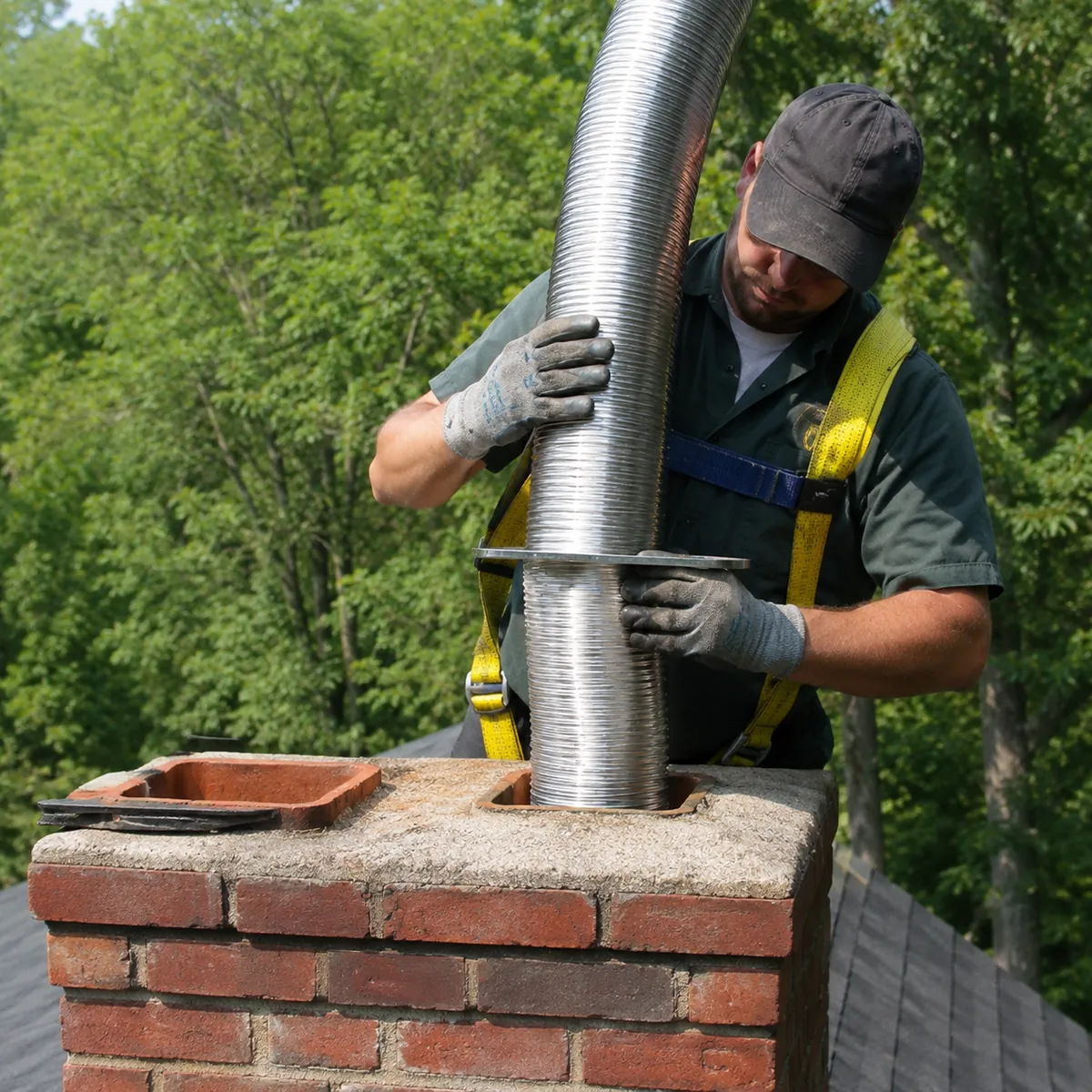
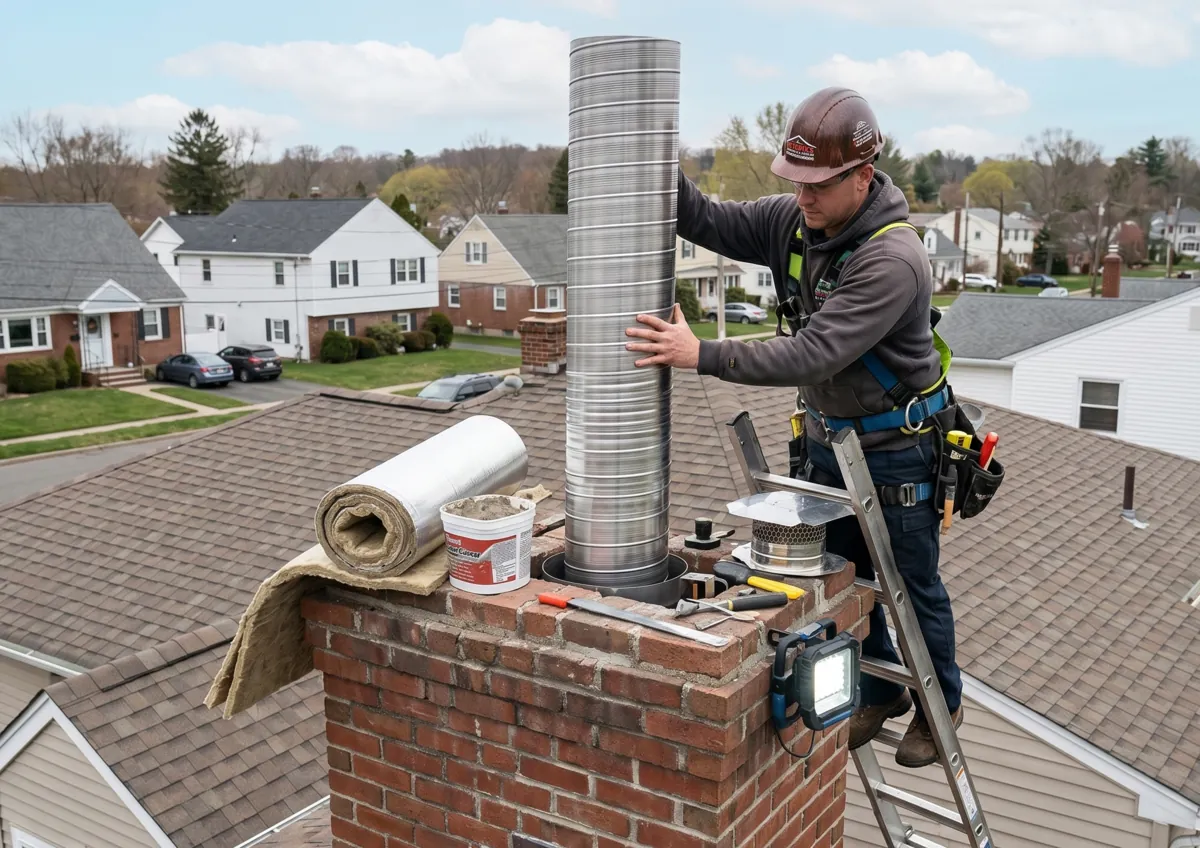
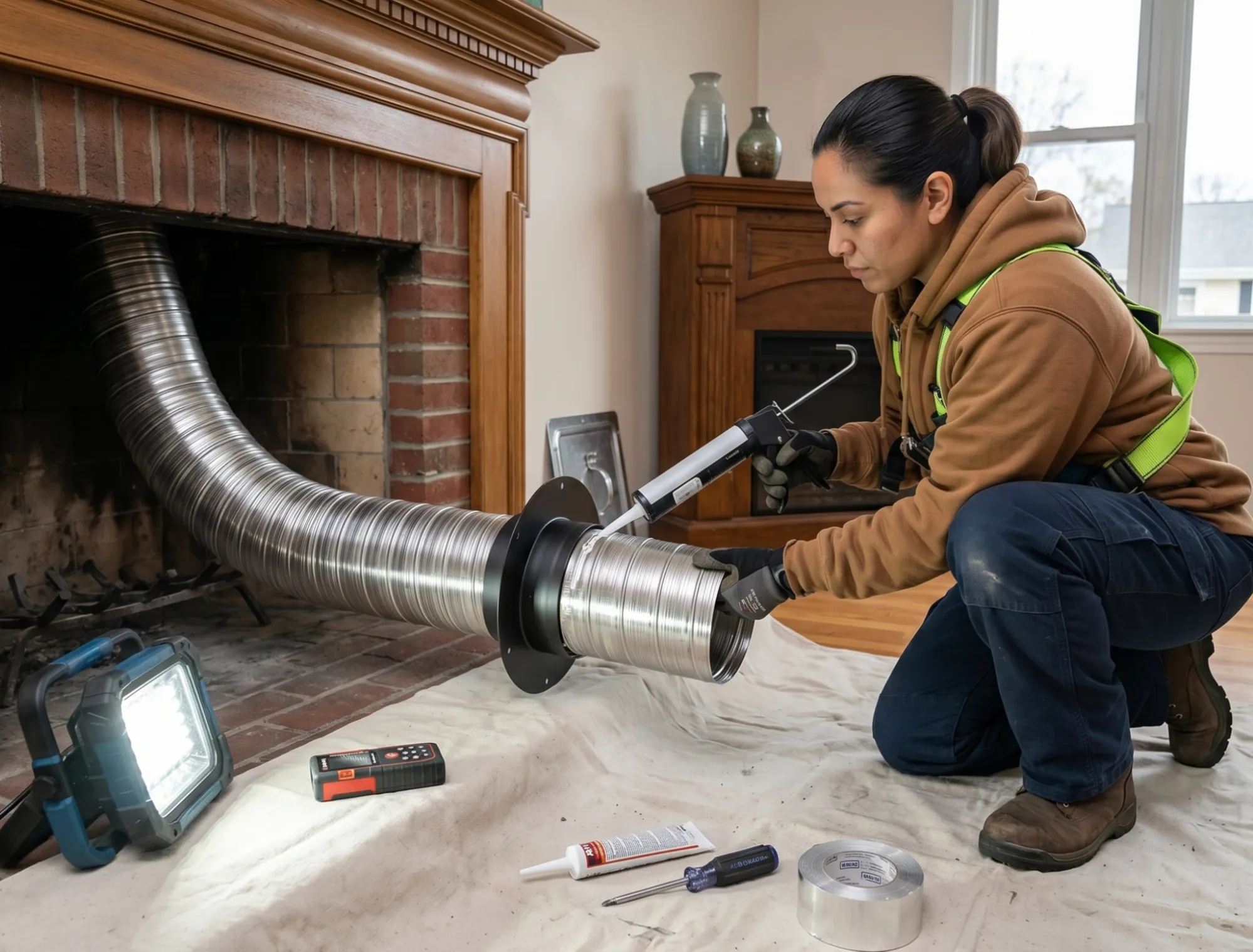
Ceramic sealant repair: the sealant system is applied through the liner using a proprietary applicator that coats the full interior surface, bridging existing cracks, sealing tile joints, and forming a smooth, continuous ceramic barrier rated for flue operating temperatures. Stainless steel relining: a correctly sized flexible 304 or 316Ti stainless steel liner is installed from the top of the chimney, connected to the appliance at the firebox end, sealed at the top plate, and insulated where the flue height and appliance type require it.
Post-Repair Camera Verification & Written Documentation
After any repair or relining is completed, a camera pass confirms the repaired or new liner is continuous, correctly seated, and free of gaps. You receive written documentation of the repair method, liner specifications, and post-repair camera findings, suitable for homeowner insurance records, real estate disclosure, and annual maintenance tracking.
What It Means
Chimney Liner Repair, Understanding the Material, the Failure, and the Right Fix
The flue liner serves three functions simultaneously: it contains combustion gases within the flue passageway so they exit at the cap rather than migrating into surrounding structure; it insulates the surrounding masonry from the thermal output of combustion, preventing heat transfer to adjacent combustibles; and it protects the chimney masonry from the corrosive chemical byproducts of combustion, particularly the sulfuric and hydrochloric acids produced by gas appliance exhaust. When the liner fails, it stops performing all three functions at every breach point. Chimney liner repair restores the continuous barrier that makes all three functions possible again.
Clay tile liners, the terracotta sections found in virtually every Los Angeles masonry chimney built before 1980, are the most commonly repaired liner type in the region and the one most directly affected by LA's specific conditions. Clay tiles are brittle under thermal shock: when a cold chimney is fired with a hot, fast-building fire, the rapid temperature differential across the tile cross-section creates internal stress that fractures the tile or its mortar joint. This is why the NFPA recommends a Level 2 inspection after any chimney fire, a chimney fire produces temperatures far above normal flue operating range, and clay tiles rarely survive the thermal shock intact. Earthquake movement is the second primary clay tile failure cause specific to Los Angeles: seismic forces displace tiles laterally within the flue, breaking the mortar joint seal that makes the liner continuous. Displaced tiles can be detected only by camera, they are invisible from the firebox and from the cap without camera equipment.
HeatShield ceramic sealant, a product system that applies a castable ceramic mixture to the liner interior using a pneumatic applicator, is the repair method that can address clay tile cracking without full relining. The system coats the complete interior surface of the flue, bridging existing cracks, sealing tile joints, and building a smooth ceramic lining over the original tile surface. The result is a continuous, seamless ceramic liner rated for full combustion temperatures, inside the existing tile structure without requiring tile removal. This approach is appropriate when the tile structure itself is geometrically intact, tiles are in position but cracked or with open joints, and is not appropriate when tiles are missing, significantly displaced, or when the liner geometry has been altered by seismic movement.
Stainless steel relining is the repair method for clay tile liners where the damage is too extensive for ceramic sealant, and for all stainless steel liners requiring replacement. A flexible 316Ti stainless steel liner, the alloy grade that includes titanium for superior acid corrosion resistance, is the appropriate specification for wood-burning applications in Los Angeles, where the combination of infrequent burning and variable wood moisture content produces the acidic condensation conditions that degrade lower-grade liners prematurely. For gas appliances, including gas inserts, gas log sets, and gas furnaces venting into masonry chimneys, liner sizing must be matched to the appliance's BTU output and vent category specifications, not simply to the existing flue diameter. An oversized liner on a gas appliance produces condensation that degrades the liner from the inside; an undersized liner creates draft and combustion performance problems.
Warning Signs
Signs Your Chimney Liner Needs Professional Assessment
Tap any sign to learn what it means and what to do next.
! Clay tile pieces or fragments in the firebox ⌄
Tile fragments falling into the firebox are direct evidence of liner deterioration above. The falling pieces represent sections of the thermal barrier that are no longer intact, and the remaining tiles in the same liner may be structurally compromised even if not yet falling. Stop using the fireplace and schedule a camera inspection before the next fire.
! Smoke or carbon monoxide odor entering living areas ⌄
When combustion gases exit the flue through liner cracks or displaced tile joints rather than through the cap, they enter wall cavities and from there migrate into living spaces. A CO detector alarm or a recurring smoke odor without an active fire both indicate an active liner breach that is allowing combustion byproducts to reach the interior of the home.
! White staining or rust inside the firebox or on the damper ⌄
Efflorescence or rust on interior firebox components, particularly on the damper, indicates that water has been reaching the firebox interior through the flue system. In a liner with moisture-damaged tile joints, rainfall enters the cracks and travels down the liner interior to the firebox below. The rust and staining are evidence of sustained water exposure through a compromised liner.
! Your chimney experienced a chimney fire ⌄
A chimney fire, characterized by a loud roaring sound, intense heat, and sometimes visible flames or dense smoke from the cap, subjects clay tile liners to thermal shock temperatures they are not designed to survive intact. A Level 2 camera inspection is required after any chimney fire before the fireplace is used again. Clay tile failure after a chimney fire is the rule, not the exception.
! Your home experienced a felt earthquake ⌄
The NFPA specifically recommends a Level 2 inspection after any significant seismic event. In Los Angeles, where felt earthquakes occur periodically and the cumulative effect of micro-seismic activity is continuous, tile displacement inside the liner is a common finding after any event that produced perceptible shaking, even if no exterior chimney damage is visible.
! A recent real estate inspection flagged the liner ⌄
Home inspectors in Los Angeles increasingly require camera inspection documentation of chimney liners as a condition of purchase. A liner flagged during a real estate inspection as cracked, deteriorated, or missing requires professional assessment and written repair documentation before the transaction can proceed.
Deep Dive
Everything You Should Know About Chimney Liner Repair
Warning Signs
The Warning Signs That Mean Liner Damage Has Reached a Safety-Critical Stage
Chimney liner failure progresses through stages, and the critical distinction is between a liner that is deteriorating and one that has breached. A deteriorating liner has cracks or open joints but remains geometrically intact: tiles are in position, the liner is continuous, and the breaches are small enough that combustion gas migration is limited. A breached liner has displaced tiles, missing sections, or cracks wide enough to allow heat transfer to adjacent combustibles or significant gas migration into surrounding structure. The difference between these two conditions is not visible from the firebox or from the cap, it is only confirmed by camera. A homeowner searching for chimney liner repair near me is often responding to an exterior symptom, a CO alarm, a smoke smell, or a failed inspection, that has already confirmed a breach. At that point, the liner is not a maintenance concern. It is an active safety hazard, and the fireplace should not be used until the repair is complete and camera-verified.
Key Points
- ✓ Clay tile or ceramic fragments falling into the firebox
- ✓ CO detector alarm or recurring smoke odor in living areas
- ✓ Efflorescence or rust on firebox interior components
- ✓ Chimney fire event, any intensity requiring Level 2 post-event inspection
- ✓ Felt earthquake, liner displacement is not visible without camera
- ✓ Real estate inspection flagging liner condition as inadequate
Benefits
The Full Case for Addressing Liner Damage Before It Requires Full Replacement
The repair-vs-replacement cost curve for chimney liners is steeper than for most other chimney components. A clay tile liner with isolated, stable cracks in an otherwise geometrically intact structure can be addressed with ceramic sealant application, a repair that costs significantly less than full stainless steel relining and that carries a warranty when combined with annual inspection and cleaning. The window for ceramic sealant repair is finite, however: once tile displacement begins, a consequence of ongoing seismic exposure or moisture-induced mortar joint failure, the liner geometry is altered, and ceramic sealant cannot bridge the resulting gaps. At that point, the only appropriate repair is stainless steel relining installed inside the existing tile structure. Stainless steel relining in turn is significantly less expensive than clay tile replacement, which requires opening the chimney masonry to remove and replace individual tiles, a repair that approaches the cost of full chimney reconstruction in some cases. Annual camera inspection catches liner damage at the ceramic sealant stage, the least expensive repair point, rather than at the relining or reconstruction stage.
Key Points
- ✓ Ceramic sealant repair costs significantly less than stainless steel relining when damage qualifies
- ✓ Stainless steel relining is significantly less expensive than clay tile replacement
- ✓ Camera-confirmed annual inspection identifies liner damage at the earliest repair stage
- ✓ Post-repair camera verification confirms the liner is continuous, not just visually cleaner
- ✓ Written liner documentation supports real estate transactions and insurance claims
- ✓ Correct stainless steel alloy selection (316Ti vs 304) prevents premature acid corrosion
Maintenance
How to Protect Your Chimney Liner Between Professional Services
The most important maintenance decision that affects liner longevity is fuel quality, specifically wood moisture content. Burning green or unseasoned wood produces a larger volume of incomplete combustion byproducts, including water vapor and tar-laden smoke that condenses on the cooler liner surfaces in the upper flue. This condensation is chemically acidic and attacks both clay tile surfaces and the mortar joints between tiles over time. Dry, seasoned hardwood, almond, oak, and walnut are practical choices for Southern California homeowners, burns at higher temperatures that keep flue gases warm enough to exit without condensing, dramatically reducing the chemical attack on liner surfaces. For gas appliance owners, the liner maintenance decision is liner sizing: an oversized liner relative to the appliance's BTU output produces draft problems and acid condensation on every operating cycle, and neither problem is addressed by cleaning. A liner sized correctly to the appliance it serves is the maintenance decision that prevents the slow acid degradation that eventually requires liner replacement. Annual professional cleaning combined with camera inspection is the service that catches early liner deterioration, before ceramic sealant becomes unavailable as a repair option and stainless steel relining becomes the only path forward.
Key Points
- ✓ Burn only dry, seasoned hardwood, moisture content below 20%
- ✓ Never burn green wood, cardboard, or treated materials that increase acid condensation
- ✓ Ensure gas appliance liners are sized correctly to the appliance BTU output
- ✓ Schedule annual cleaning plus camera inspection, not cleaning alone
- ✓ Inspect after any felt earthquake regardless of no visible exterior symptoms
- ✓ Address any real estate inspection liner findings with professional repair and written documentation
What's Included
Complete Liner Assessment and Repair, No Surprises After the Camera Goes In
Every chimney liner repair service begins with a camera inspection that documents the complete liner condition before any repair method is recommended. Chimney liner repair cost is determined by what the camera actually finds, not by a standard package applied before inspection. Written estimate confirmed before work begins.
- ✓ Level 2 camera inspection, full flue interior, firebox to cap
- ✓ Liner material identification, clay tile, stainless steel, or unlined assessment
- ✓ Damage mapping, crack location, displacement, and extent documentation
- ✓ Ceramic sealant repair (HeatShield equivalent), for qualified clay tile liners
- ✓ Stainless steel flexible liner installation, 304 or 316Ti alloy, correctly sized to appliance
- ✓ Liner insulation, vermiculite or ceramic fiber wrap where appliance type requires
- ✓ Top plate installation and cap integration
- ✓ Firebox connection and appliance interface sealing
- ✓ Post-repair camera verification, liner continuity confirmed
- ✓ Written service record, liner specification, repair method, and camera findings
15+ Years Serving Southern California Homeowners
Our Promise
You'll Always Know What You're Paying, Before We Start
No repair recommendations made before the camera goes in. No liner replacement recommended when ceramic sealant repair is the appropriate approach. You receive a camera-documented assessment, a written repair recommendation with liner specification, and a chimney liner repair cost confirmed before any work begins. Every repair is backed by our workmanship guarantee and documented with post-repair camera verification.
CSIA-Certified Liner Technicians
Every liner assessment and repair is performed by a certified, insured professional with specific training in liner material identification, camera inspection protocol, and NFPA 211 liner requirements.
Written Estimates With Liner Specification
You see the camera findings, the recommended repair method, the liner specification (alloy grade, diameter, insulation requirement), and the cost before we begin. What we quote is what you pay.
Same-Day Scheduling
Liner assessment and repair appointments available across Los Angeles, Pasadena, Burbank, Glendale, Santa Monica, and the San Fernando Valley, with priority scheduling for active CO concerns and real estate transaction timelines.
Post-Repair Camera Verification & Guarantee
Every liner repair is verified by a post-repair camera pass confirming the liner is continuous and correctly installed. Every repair is backed by our workmanship guarantee, if the same liner failure returns within the warranty period, we return to address it at no charge.
FAQs
Quick answers from our techs.
Still have a question? Call us, we answer the phone, day or night.
Call (888) 280-2285 →What is the chimney liner repair cost in Los Angeles?
Chimney liner repair depends on the repair method required. Ceramic sealant application is often used for qualified clay tile liners, while stainless steel relining is a common solution for many residential chimneys. The main factors that affect the repair process include flue height, liner diameter, alloy grade, and whether insulation is required for the appliance type. Every estimate we provide is camera-based and delivered in writing before work begins.
Can a cracked clay tile liner be repaired without full replacement?
Sometimes, it depends on the nature and extent of the damage. Clay tile liners with isolated, stable cracks in tiles that remain in their correct position are candidates for ceramic sealant repair systems like HeatShield, which coat the full liner interior and bridge existing cracks. Clay tile liners with displaced tiles, missing sections, or widespread cracking require stainless steel relining installed inside the existing tile structure. Camera inspection confirms which condition exists before any repair recommendation is made.
Does chimney liner repair require a permit in Los Angeles?
Ceramic sealant repair (liner resurfacing) typically does not require a permit. Stainless steel liner installation may require a permit in some Los Angeles jurisdictions, particularly when the liner is associated with a gas appliance installation that is itself permitted. We verify permit requirements for your specific address and handle documentation where required.
How do I know if I need liner repair or full relining?
The repair approach is determined by camera inspection, not by the surface symptoms. Symptoms like CO detector alarms, smoke odors, or tile fragments in the firebox indicate a liner problem, but they do not indicate whether repair or relining is appropriate. Only camera documentation of the specific damage type, location, and extent allows that determination to be made accurately. We perform this assessment as the first step of every chimney liner repair service.
Is a chimney liner inspection required when selling a home in Los Angeles?
While not universally mandated by California law, the vast majority of real estate transactions in Los Angeles that involve a property with a fireplace now include a chimney inspection as a buyer contingency. Level 2 camera inspections, which include full documentation of the flue liner condition, are the standard for real estate transactions. A liner flagged as cracked, deteriorated, or missing typically must be repaired or relined with written documentation before close of escrow.
Service Areas
Air Duct & Chimney Services Across Los Angeles County
SoCal Green Air Duct & Chimney provides air duct cleaning, chimney sweeping, dryer vent cleaning, and indoor air quality services throughout Los Angeles County. Our certified technicians serve residential and commercial properties across these communities and beyond.
Ready to Find Out What Your Chimney Liner Actually Needs?
Book a professional chimney liner repair assessment today. Camera inspection, written findings, and a repair recommendation with confirmed cost, before any work begins. Most appointments across Los Angeles and Southern California are available within 48 hours.