
Dryer Vent Blockage Removal Services
Clogged Dryer Vent & Blockage Removal Los Angeles
A clogged dryer vent is not a routine maintenance issue, it's an active safety emergency. When the exhaust path is fully or severely blocked, the dryer runs dangerously hot, lint-packed material sits against the heating element, and gas dryers lose the combustion airflow needed to vent carbon monoxide safely outside. Our certified technicians provide same-day dryer vent blockage removal across Los Angeles, diagnosing the blockage type, extracting the material completely, and confirming restored airflow before we leave. Stop the dryer. Call us now.
The Problem
What Causes a Complete Dryer Vent Blockage
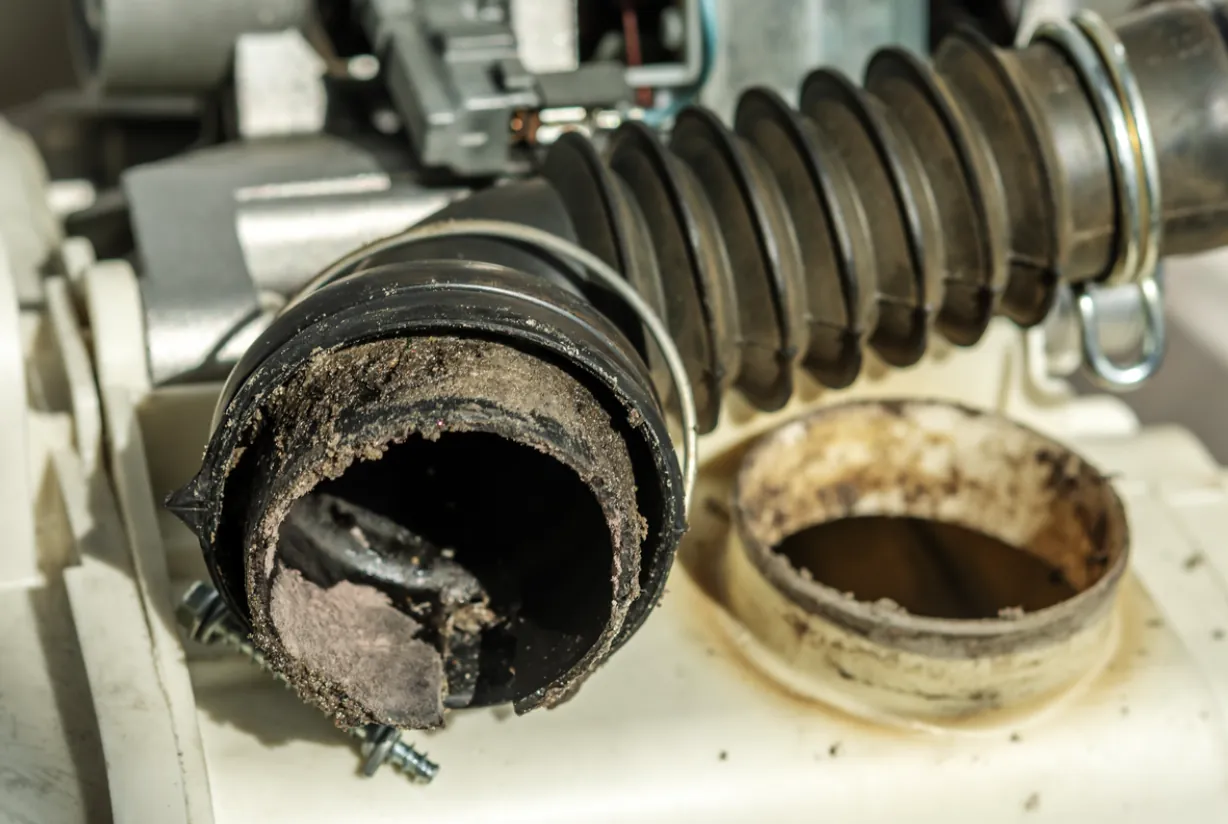
A clogged dryer vent is different from a dirty one. Gradual lint buildup restricts airflow progressively, a blockage stops it. The distinction matters because the hazard level is categorically different: a dryer operating against a complete or near-complete blockage reaches internal temperatures that can ignite the very material causing the stoppage. In Los Angeles, blockages happen for reasons beyond lint accumulation alone. The region's mild, year-round climate makes uncapped or louvered dryer vents attractive nesting sites for house sparrows, European starlings, and pigeons, species active across Pasadena, Glendale, Silver Lake, and the San Fernando Valley from early spring through late summer. A single active nest can fully block a vent in 24 to 48 hours. Compressed lint impaction, where years of partial restriction suddenly collapses into a complete seal under heat and moisture, is the other primary cause, and it requires extraction, not brushing.
- ⚠ Bird nesting: starlings, sparrows & pigeons pack vents with twigs, grass, feathers & debris
- ⚠ Lint impaction: years of restriction collapse into a dense, heat-compressed seal
- ⚠ Exterior cap failure: flap stuck closed or sealed with paint, rust, or debris
- ⚠ Foreign object obstruction: small items entering the duct from inside or outside
- ⚠ Moisture-bonded lint: coastal humidity causes lint to absorb moisture and bond to duct walls into a semi-solid mass
- ⚠ Rodent nesting: rats and mice entering through uncapped vents, common in older LA homes
The Solution
Blockage-Specific Extraction, Diagnosed Before Anything Is Removed
Removing a full dryer vent blockage is not the same process as annual vent cleaning. Pushing a rotary brush into a bird nest or a compressed lint impaction drives the material deeper and harder, making extraction significantly more difficult. Our technicians camera-inspect the full duct before selecting the correct extraction approach. Bird nests are extracted from the blockage point using specialized retrieval tools, then the duct is brushed and vacuumed clear of residual nesting material and lint. Compressed lint impactions are broken up mechanically and extracted with high-powered vacuum equipment. Every blockage removal is completed with a post-service airflow measurement to confirm the duct is fully clear.
Get Free Estimate →Benefits
Why Homeowners Call Us for Blocked Vent Removal
Eliminates an Active Fire Hazard
A dryer running against a complete blockage is actively generating the conditions for ignition, heat, fuel, and airflow converging at a packed obstruction. Extraction removes the hazard, not just the symptom.
Restores Safe Operation for Gas Dryers
Gas dryers require unrestricted exhaust to vent carbon monoxide outside. A blocked vent on a gas appliance is a CO risk in addition to a fire risk. Full blockage removal restores the safe combustion pathway.
Same-Day Service Available
A clogged dryer vent is not a schedule-when-convenient situation. We offer same-day blockage removal appointments across Los Angeles and surrounding communities, because the dryer should stay off until the vent is clear.
Confirmed Clear Before We Leave
Every blockage removal is verified with an airflow measurement at the exterior termination point. You see the number, not just our assurance that it's done.
Our Process
What to Expect, Step by Step
Camera Inspection & Blockage Assessment
Before any extraction begins, we run a camera through the full duct length to identify the exact location, type, and extent of the blockage. This step determines the correct extraction approach, pushing the wrong tool into a bird nest or compressed impaction makes the situation worse, not better. Drop cloths and containment are placed before inspection begins.
Blockage Extraction, Method Matched to Material
Bird nests are extracted using retrieval tools designed to grip and pull nesting material out from the blockage point, not push it deeper. Compressed lint impactions are broken up with mechanical agitation tools and extracted simultaneously with high-powered vacuum equipment. Foreign object blockages are located precisely by camera and removed with appropriate retrieval equipment.
Full Duct Clearing & Residual Material Removal
After the primary blockage is extracted, the complete duct is brushed and vacuumed to remove residual nesting debris, compressed lint, and any material dislodged during extraction. The exterior cap is removed, inspected, and cleared of any compacted debris at the flap mechanism.
Airflow Verification, Cap Assessment & Prevention Recommendations
A calibrated airflow meter confirms exhaust volume at the exterior termination, documented before and after. The existing exterior cap is assessed for damage and pest-resistance. If the cap contributed to the blockage or is absent, we provide options for replacement with a pest-proof model before we leave.
What It Means
Dryer Vent Blockage Removal, Why It's Different From Routine Cleaning
A clogged dryer vent needs a fundamentally different response than a dirty one. Routine cleaning handles loose lint spread along the duct, removable with rotary brushing and vacuum extraction. A complete blockage is a concentrated, compacted obstruction at one point and standard tools pushed into it compress it further rather than breaking it up. Camera inspection before any tool enters the duct isn't optional; it pinpoints the location, composition, and extent of the obstruction and sets the correct extraction approach.
Bird nests are the most complex type. European starlings and house sparrows build interlocking nests of grass, straw, feathers, and mud that pack tighter as the dryer's heat dries them until a partial restriction becomes a full seal. With dry organic material, lint, and confined heat in one duct section, the fire triangle is complete. Extraction means pulling the nest out from the blockage point; pushing it toward the exterior only drives it deeper.
Compressed lint impaction is the second type, and the one most often mistaken for a cleaning issue. Years of partial buildup combined with drying-cycle moisture common in coastal LA's marine layer let lint bond into a semi-solid mass a one-end rotary brush can't break up. It takes mechanical agitation with simultaneous high-powered extraction.
Exterior cap failure a flap sealed by paint, corrosion, or debris is the third cause and the easiest to misdiagnose, since a perfectly clean duct produces identical symptoms. Interior camera inspection plus an exterior check identifies it fast, and the solution is dryer vent repair to fix or replace the cap, not duct cleaning.
Warning Signs
Signs Your Dryer Vent May Be Completely Blocked
These signs are different from routine performance decline, they indicate an urgent condition. Stop using the dryer until the vent is inspected.
! Dryer runs a full cycle but clothes are still wet ⌄
Not damp, wet. When the exhaust path is completely blocked, hot air cannot exit the drum at all. The heating element runs, the drum turns, but moisture has nowhere to go. Clothes finish a normal cycle in the same condition they started.
! No airflow detectable at the exterior vent opening ⌄
Hold your hand near the exterior vent cap while the dryer is running. If you feel no air movement at all, not reduced airflow, nothing, the duct has a complete or near-complete blockage somewhere between the dryer and the termination point.
! Burning smell with no prior history of odor during cycles ⌄
A burning smell that appears suddenly, not gradually over weeks, often indicates that accumulated material has reached the temperature threshold where it begins to scorch. This is a pre-ignition warning. Stop the dryer immediately and do not restart it.
! Visible nesting material at the exterior vent opening ⌄
Straw, feathers, grass, or twigs visible at or protruding from the exterior cap are direct evidence of an active or recent bird nest inside the duct. The nest material visible at the opening represents only the outermost portion, the mass extends inward.
! Dryer shuts off mid-cycle repeatedly ⌄
Modern dryers have thermal overload protection that trips when internal temperature exceeds a safe threshold. A dryer that repeatedly shuts off during a normal cycle is detecting dangerous heat buildup, almost always caused by a severe exhaust restriction or complete blockage preventing heat from escaping.
! Musty, organic, or decaying smell from the laundry area ⌄
A musty or organic odor, particularly one that wasn't present previously, coming from the dryer or laundry area can indicate a bird nest or rodent nest inside the duct that's accumulating moisture, droppings, and decaying organic material. This is both a blockage and a health concern.
Deep Dive
Everything You Should Know
Warning Signs
When a Clogged Dryer Vent Becomes an Emergency, Not Just a Problem
The distinction between a restricted dryer vent and a blocked one is a matter of degree, but the risk difference is not gradual. A dryer operating against 50% restriction runs inefficiently and costs more to operate. A dryer operating against a complete or near-complete blockage runs its heating element at temperatures significantly beyond design parameters, with nowhere for that heat to go except back into the drum and the surrounding duct walls. The lint and nesting material packed at the blockage point is in direct contact with a heat source that, in a fully blocked system, is no longer being cooled by exhaust airflow. This is the condition that precedes dryer fires. The NFPA identifies failure to clean as the leading cause of dryer fires, but the fires that result in significant property damage are almost always complete blockage events, not gradual accumulation events. If any of the warning signs above are present, the dryer should be off and unplugged until the vent is professionally inspected and cleared.
Key Points
- ✓ Clothes still wet after a complete drying cycle
- ✓ Zero airflow at the exterior vent opening during dryer operation
- ✓ Dryer repeatedly tripping thermal overload and shutting off mid-cycle
- ✓ Sudden burning smell with no prior history of odor
- ✓ Visible nesting material at or around the exterior cap
- ✓ Musty or organic odor from the dryer or laundry area without recent use
Benefits
Why Professional Blockage Extraction Is the Only Safe Response to a Clogged Dryer Vent
The instinct to push something into a blocked duct and force the material through is understandable, and almost always makes the situation worse. Bird nests are interlocked organic structures that become more tightly bound when compressed. Pushing a standard vent brush into a nest from the exterior cap drives it deeper, compacts it harder, and in many cases embeds lint from the surrounding duct into the nesting material, creating a denser, more difficult obstruction further from either access point. Compressed lint impactions behave similarly: a brush that can't break up the compacted mass from one end simply relocates it. Professional blockage removal starts with camera inspection that identifies the exact location and composition of the blockage before any tool enters the duct. The correct extraction tool is then used from the correct direction, pulling material out toward the nearest access point rather than pushing it toward an unknown one. Every extraction is followed by a full-duct brush-and-vacuum pass to remove all residual material, and every service ends with a documented airflow measurement confirming the duct is clear, not assumed clear based on the absence of obvious resistance.
Key Points
- ✓ Camera inspection identifies blockage type and location before any tool is used
- ✓ Bird nests extracted with retrieval tools, not pushed through with a brush
- ✓ Compressed lint impactions broken up mechanically and extracted simultaneously
- ✓ Full duct cleared of residual material after primary blockage is removed
- ✓ Exterior cap inspected and assessed for pest-proofing after every blockage removal
- ✓ Airflow confirmed with measurement, not assumed based on reduced resistance
Maintenance
How to Prevent a Clogged Dryer Vent From Happening Again
The single most effective step after a blockage removal is a pest-proof exterior vent cap. Standard plastic louvered caps found on most LA homes have lightweight flaps that house sparrows and starlings push open easily, and birds return to a nested vent every season unless the access point is physically changed. Pest-resistant caps use spring-loaded or magnetic dampers with recessed housings that birds can't grip a low-cost, high-impact upgrade after any bird-nest removal. For lint impaction, the cause is usually deferred cleaning plus moisture, so annual professional dryer vent cleaning prevents the buildup that compacts under heat and humidity. In coastal areas like Santa Monica, Venice, and the South Bay, biannual cleaning is worth considering.
Key Points
- ✓ Install a pest-resistant exterior vent cap immediately after any bird nest removal
- ✓ Check the exterior cap condition at the start of each nesting season (February to March)
- ✓ Never leave the exterior vent cap absent or damaged, any opening invites nesting
- ✓ Schedule annual professional vent cleaning to prevent lint impaction recurrence
- ✓ Consider biannual cleaning for coastal properties with consistent marine layer humidity
- ✓ Do not run the dryer if blockage is suspected, thermal damage and fire risk escalate rapidly
What's Included
A Complete Blockage Removal Service, No Add-On Surprises
Every dryer vent blockage removal service begins with camera inspection and ends with confirmed airflow measurement. One flat rate, stated before any work begins. No fees added based on blockage type, location, or what the camera finds.
- ✓ Pre-service camera inspection, full duct length
- ✓ Pre-service airflow measurement at exterior termination
- ✓ Blockage extraction, bird nest, lint impaction, or debris (method matched to material)
- ✓ Full-duct brush-and-vacuum pass after extraction
- ✓ Exterior cap removal, inspection & manual clearing
- ✓ Residual nesting material and debris removal
- ✓ Dryer reconnection and operational test
- ✓ Post-service airflow measurement, documented result
- ✓ Exterior cap condition assessment & pest-proof replacement options
- ✓ Written service record with before-and-after airflow readings
15+ Years Serving Southern California Homeowners
Our Promise
You'll Always Know What You're Paying, Before We Start
No estimates that change after the camera goes in. No fees added for blockage type or extraction difficulty. You receive a flat-rate written estimate after camera inspection, and a documented post-service airflow reading that confirms the vent is clear, not just less blocked. If airflow isn't fully restored in a single visit, we return to complete the job at no additional charge.
Certified Technicians
Every blockage removal is performed by a trained, certified professional with hands-on experience across all blockage types, lint impaction, bird nests, debris, and exterior cap failure.
Written Estimates After Inspection
Camera inspection first, pricing second. You see exactly what was found and what removal costs before we extract anything. What we quote is what you pay.
Same-Day Service
Dryer vent blockages are same-day priority. We schedule across Los Angeles, Burbank, Glendale, Pasadena, Santa Monica, and the San Fernando Valley, and we arrive with the right equipment to handle every blockage type without a return trip for additional tools.
Confirmed Clear, Not Just Assumed
Every blockage removal ends with a documented airflow reading at the exterior termination. You see the measurement that confirms the duct is clear, not a technician's verbal assurance.
FAQs
Quick answers from our techs.
Still have a question? Call us, we answer the phone, day or night.
Call (888) 280-2285 →Can I run my dryer if I think the vent is blocked?
No. A dryer operating against a complete or near-complete blockage reaches internal temperatures that can ignite the material causing the blockage. For gas dryers, a blocked vent also prevents carbon monoxide from venting safely outside. Stop the dryer, unplug it if possible, and call for professional inspection before running another cycle.
What's the most common cause of a completely clogged dryer vent in Los Angeles?
Bird nesting is the primary cause of sudden, complete blockages in LA, particularly from European starlings and house sparrows, which are active nesting in the region from early March through late summer. Compressed lint impaction, where progressive buildup collapses into a full seal under heat and moisture, is the second most common cause, particularly in homes that haven't had professional cleaning in two or more years.
Can a bird nest be pushed through the vent with a standard brush?
No, and attempting to do so makes the situation significantly worse. Bird nests are interlocked organic structures that become more tightly compacted when pushed. Pushing a brush into a nest from the exterior cap drives it deeper into the duct, embeds surrounding lint into the nesting material, and creates a harder, more difficult impaction further from any access point. Camera inspection followed by directional extraction is the correct approach.
How is dryer vent blockage removal different from standard vent cleaning?
Standard vent cleaning addresses progressive lint accumulation distributed across the duct length using rotary brush agitation and vacuum extraction. Blockage removal addresses a concentrated obstruction at a specific point, requiring camera inspection to locate it, extraction tools matched to the blockage material, and a separate full-duct clearing pass after the primary blockage is removed. They are different service protocols, not the same process applied at different severity levels.
How do I prevent another blockage after removal?
The most important step is installing a pest-resistant exterior vent cap immediately after any bird nest blockage removal. Standard louvered plastic caps are easily pushed open by nesting birds, a spring-loaded or magnetic damper cap with a recessed housing prevents re-entry. For lint impaction prevention, annual professional dryer vent cleaning prevents the progressive accumulation that eventually becomes a complete blockage.
Service Areas
Air Duct & Chimney Services Across Los Angeles County
SoCal Green Air Duct & Chimney provides air duct cleaning, chimney sweeping, dryer vent cleaning, and indoor air quality services throughout Los Angeles County. Our certified technicians serve residential and commercial properties across these communities and beyond.
Suspected Blockage? Stop the Dryer and Call Now.
Dryer vent blockage removal is a same-day priority service. We serve Los Angeles and surrounding communities with camera inspection, complete extraction, and confirmed airflow restoration, in a single visit. Do not run the dryer again until the vent is confirmed clear.