Dryer Vent Fire Prevention Services
Dryer Vent Fire Prevention Service Los Angeles
The NFPA reports that dryers cause an average of 15,970 home fires per year in the United States, and a dryer fire occurs somewhere in the country every 30 minutes. More than one-third of those fires are directly attributed to failure to clean. But lint accumulation is only one of the conditions that creates ignition risk. Prohibited duct materials, improper vent routing, failed thermal protection components, and damaged gas connections all contribute independently to dryer fire risk, and none of them are addressed by cleaning alone. Our certified technicians provide a complete dryer vent fire prevention assessment in Los Angeles that covers every ignition risk factor in your system. One visit. Written findings. Flat-rate pricing.
The Problem
Why Dryer Fires Keep Happening, and Why Cleaning Alone Doesn't Prevent Them
Most homeowners understand that a dirty dryer vent is a fire risk. What fewer understand is that lint accumulation is one of four distinct ignition pathways in a dryer vent system, and the only one that cleaning directly addresses. A dryer with a prohibited plastic transition hose, a vent run with six 90-degree bends, a failed high-limit thermostat, and a gas connection that hasn't been inspected in a decade can still burn a house down even if the lint screen is spotless. In Los Angeles, older housing stock across Pasadena, Glendale, Eagle Rock, and the San Fernando Valley compounds the risk: many homes still have foil accordion transition hoses installed during original construction decades ago, a material explicitly prohibited by IRC Section M1502 and explicitly flagged in every major dryer manufacturer's installation manual as a fire hazard.
- ⚠ Lint accumulation: flammable material in contact with the heating element pathway
- ⚠ Prohibited duct materials: plastic and foil flex hose collapse, trap lint, and are not rated for dryer exhaust temperatures
- ⚠ Airflow restriction: long vent runs and excessive bends prevent heat dissipation, the thermal overload the dryer was designed to prevent
- ⚠ Thermal protection failure: high-limit thermostat and thermal fuse degradation removes the last safety barrier between overheating and ignition
- ⚠ Gas connection condition: flexible gas line deterioration and connection integrity, the CO and combustion risk specific to gas appliances
- ⚠ Exterior cap condition: stuck or blocked flaps create back-pressure that forces heat accumulation inside the system
The Solution
A Multi-Layer Fire Prevention Assessment, Every Risk Factor, One Visit
Dryer vent fire prevention is a structured risk assessment, not a single service task. Our certified technicians evaluate every component and condition in your dryer's exhaust system that contributes to fire risk: lint accumulation level, transition hose material and condition, vent run length and bend count, airflow performance against manufacturer specifications, exterior cap function, and visible thermal protection component condition. You receive a written risk assessment with findings and recommended actions, so you know exactly where your system stands against every relevant fire risk factor.
Get Free Estimate →Benefits
Why Homeowners Choose a Fire Prevention Assessment
Identifies Every Ignition Risk, Not Just Lint
A complete fire prevention assessment covers all four ignition pathways: lint accumulation, prohibited materials, airflow restriction, and thermal protection condition. Cleaning alone addresses one.
Written Risk Findings You Can Act On
You receive a written assessment of every identified risk factor, what was found, what it means, and what correction is needed. Not a verbal summary. A document.
Protects Multi-Unit Properties From Fire Spread
In condos and apartment buildings across Los Angeles, a dryer fire in one unit can spread to adjacent units through shared wall cavities. A fire prevention assessment is the property manager's due diligence tool.
Insurance and Liability Documentation
A written fire prevention assessment creates a documented record of proactive maintenance. This matters for homeowner insurance claims, property manager liability, and real estate transactions.
Our Process
What to Expect, Step by Step
Pre-Assessment Airflow & System Review
Before any component is inspected in detail, we measure exhaust airflow at the exterior termination and compare it to the dryer manufacturer's minimum required CFM rating. This baseline tells us how restricted the system currently is, and how far it falls from safe operating parameters. We review the dryer's installation documentation and note the appliance type, electric or gas, since each carries distinct fire risk profiles.
Transition Hose & Duct Material Inspection
The transition hose, the connector between the dryer exhaust port and the wall duct, is the single most common prohibited material location in Los Angeles homes. We identify the material type (rigid aluminum, semi-rigid aluminum, foil flex, or plastic flex), assess its condition, confirm it meets IRC Section M1502 requirements, and document any code violations. The accessible duct sections are inspected for crushing, kinking, and joint integrity.
Vent Path Assessment, Length, Bends & Termination
We map the complete vent path, measuring total duct length, counting 90-degree and 45-degree bends, and calculating the effective equivalent length against IRC and manufacturer maximum allowances. A vent run that exceeds safe equivalent length cannot dissipate heat correctly regardless of how clean it is. The exterior termination cap is physically inspected for flap operation, pest infiltration, and obstruction.
Lint Removal, Risk Report & Prevention Recommendations
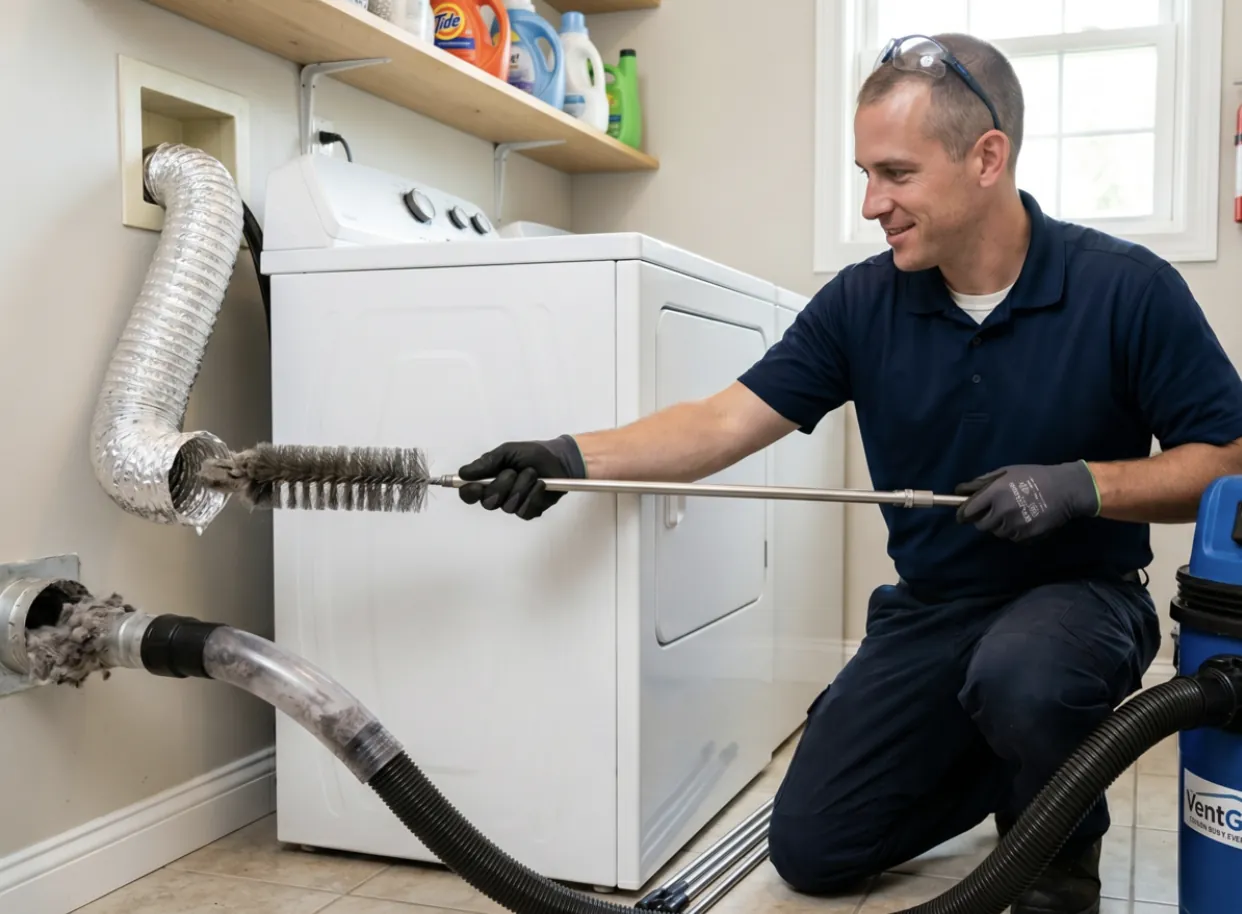
The duct is cleaned using rotary brush agitation and high-powered vacuum extraction. A written fire prevention risk report is prepared, documenting every identified condition, its risk classification, and the recommended corrective action. We walk through findings before we leave, answer questions, and prioritize any items that require immediate attention.
What It Means
Dryer Vent Fire Prevention, Understanding All Four Ignition Pathways
A dryer fire needs fuel, heat, and oxygen and a dryer vent system always supplies all three: lint as fuel, the heating element as heat, and the blower motor feeding air even as the duct restricts. Fire prevention means removing the conditions that let those elements reach ignition together, which takes addressing all four risk pathways, not just the visible one.
First is lint accumulation. As lint narrows the duct, heat gets trapped and the dryer calls for more. The high-limit thermostat should interrupt that cycle, but one worn by repeated tripping may not and the thermal fuse, the last fail-safe, only confirms the system already overheated.
Second is prohibited duct material. Plastic and foil accordion duct collapse under blower pressure and trap lint, which is why IRC Section M1502 bans both for dryer exhaust. This is a fire risk independent of lint level correcting it means replacing the run with code-compliant aluminum duct through professional dryer vent repair.
Third is excessive vent run length. Every foot of duct and every bend adds resistance, so IRC Section M1502 caps equivalent length at roughly 25 feet. Older LA homes often have laundry rooms far from exterior walls, producing runs that exceed code and a vent twice the allowable length overheats every cycle, no matter how often it's cleaned.
A flap that barely opens during a cycle signals a severe airflow restriction the dryer is generating heat it can't exhaust, pushing internal temperatures toward ignition on every load. A restriction this severe calls for dryer vent blockage removal before the dryer is safe to run.
Warning Signs
Signs Your Dryer Vent System Has an Active Fire Risk
These are not performance complaints, they are fire risk indicators. Each one warrants immediate professional inspection.
! Dryer trips thermal overload and shuts off during a cycle ⌄
A dryer that shuts itself off before a cycle completes has activated its thermal overload protection, meaning the internal temperature already reached an unsafe threshold. This is not a mechanical fault. It's the system's last safety mechanism responding to a genuine overheat condition caused by restricted airflow.
! Burning smell that appears without visible smoke ⌄
A scorched-lint odor during or after a drying cycle means lint in the duct has reached a temperature where it begins to pyrolyze, the thermal decomposition stage that immediately precedes ignition. The dryer should be stopped, unplugged, and not restarted until the vent is professionally inspected.
! You can see a white plastic or foil accordion transition hose ⌄
If the hose connecting your dryer to the wall duct is white plastic or silver foil accordion material, it is a prohibited material under current building code and an active fire risk regardless of its apparent condition. Replacement is not optional maintenance, it is a code-compliance requirement.
! The exterior vent flap doesn't open fully during operation ⌄
A flap that barely opens, or doesn't open at all, during a drying cycle indicates a severe airflow restriction somewhere in the system. The dryer is generating heat it cannot exhaust. Internal temperatures are rising on every load toward the threshold where ignition becomes possible.
! The dryer has never had a professional inspection ⌄
If the dryer has been in use for two or more years without a professional vent inspection and cleaning, the system has accumulated lint in sections no consumer tool reaches, and the transition hose and vent path have never been assessed for code compliance. This is not a maintenance gap. It's an uninspected fire risk.
! Clothes come out hotter than the room temperature warrants ⌄
Clothes that feel significantly hotter than expected at the end of a cycle, particularly on a mild Los Angeles day, are retaining heat that the dryer was unable to exhaust. The dryer is running hotter than it should because the vent cannot remove the heat it produces.
Deep Dive
Everything You Should Know
Warning Signs
The Warning Signs That Mean Your Dryer Presents an Active Fire Risk Right Now
Dryer fires do not happen randomly. They follow a predictable sequence that builds over time, often across months or years of deferred maintenance and unaddressed code violations, before a single load triggers ignition. The warning signs are present well before that point. A dryer that trips its thermal overload, emits a burning smell, or has a prohibited transition hose is communicating the same message in different ways: the system is operating outside its safe parameters. The NFPA's fire causation data is consistent across reporting periods, failure to clean accounts for approximately one-third of dryer fires, and equipment malfunction accounts for much of the remainder. Equipment malfunction in this context almost always means thermal protection failure following chronic overheating from an undersized or restricted vent path. Both causes are preventable. Neither requires a fire to identify. A professional fire prevention assessment finds them first.
Key Points
- ✓ Dryer shutting off mid-cycle, thermal overload activation
- ✓ Burning smell without visible smoke, lint at pre-ignition temperature
- ✓ Prohibited plastic or foil flex transition hose visible behind the dryer
- ✓ Exterior vent flap not opening fully during dryer operation
- ✓ Clothes significantly hotter than expected at cycle end
- ✓ No professional vent inspection in the past 12 months or more
Benefits
The Full Case for a Structured Fire Prevention Assessment
The difference between annual vent cleaning and a dryer vent fire prevention assessment is the difference between addressing one ignition pathway and addressing all four. Cleaning removes lint, the most common fuel source. A fire prevention assessment also identifies prohibited duct materials that are a fire risk independent of lint level, vent path geometry that prevents safe heat dissipation regardless of cleaning frequency, thermal protection component condition that determines whether the dryer's last fail-safes will actually function, and exterior cap integrity that affects every other condition downstream. For homeowners in Los Angeles's multi-unit housing stock, condos in Koreatown, apartments in Mid-City, townhouses throughout the Westside, the stakes of an unaddressed dryer fire risk extend beyond the individual unit. Wall cavities in multi-unit construction are shared pathways. A dryer fire that starts in one unit's laundry closet can travel through the wall cavity to adjacent units before the first smoke alarm activates. A written fire prevention assessment is the documented evidence that a property owner or manager exercised reasonable care, and it's the document that matters most if a fire does occur.
Key Points
- ✓ Identifies all four ignition pathways, not just lint accumulation
- ✓ Documents prohibited duct materials requiring immediate code-compliant replacement
- ✓ Assesses vent run geometry against IRC maximum equivalent length limits
- ✓ Evaluates thermal protection component condition, thermostat and thermal fuse
- ✓ Produces written risk findings for insurance, property management, and real estate purposes
- ✓ Reduces liability exposure for property owners and managers of multi-unit buildings
Maintenance
Building a Prevention Routine That Actually Reduces Fire Risk
Dryer vent fire prevention is not a one-time event, it's a maintenance posture. The foundation is annual professional inspection and cleaning: lint removed from every duct section, vent path geometry confirmed against current code, transition hose material verified as code-compliant, airflow measured against manufacturer specifications, and exterior cap inspected for function and pest-resistance. Between annual services, the daily habits that most directly reduce fire risk are consistent lint screen clearing before every load and never leaving the dryer running unattended, particularly at night or when leaving the house. The NFPA specifically recommends turning the dryer off before leaving home or going to bed because a dryer fire that starts while the household is absent or asleep has the longest possible time to spread before detection. In Los Angeles, where older homes throughout the East Side and Northeast LA often have laundry facilities in garages or utility rooms that are separated from sleeping areas, this recommendation carries added weight. Annual professional assessment plus consistent daily habits is the complete prevention protocol, neither replaces the other.
Key Points
- ✓ Schedule annual professional dryer vent fire prevention assessment, not just cleaning
- ✓ Clear the lint screen before every load without exception
- ✓ Never run the dryer unattended, particularly overnight or when leaving the home
- ✓ Confirm transition hose material is semi-rigid or rigid aluminum, never plastic or foil flex
- ✓ Test the exterior vent flap opens fully when the dryer is operating, check quarterly
- ✓ If the dryer trips thermal overload, stop using it and call for inspection before restart
What's Included
A Complete Prevention Assessment, No Add-On Surprises
Every dryer vent fire prevention service covers the full system, from the dryer's exhaust port to the exterior termination point, with written findings delivered before we leave. One flat rate. No fees added for what the inspection uncovers.
- ✓ Pre-service airflow measurement, compared to manufacturer minimum CFM
- ✓ Transition hose material identification & IRC compliance assessment
- ✓ Vent run length and bend count, compared to IRC Section M1502 limits
- ✓ Full duct cleaning, rotary brush agitation & high-powered vacuum extraction
- ✓ Exterior cap inspection, flap operation, obstruction, pest-resistance
- ✓ Appliance type documentation, electric vs gas risk profile
- ✓ Visible thermal protection component condition assessment
- ✓ Post-service airflow measurement & comparison
- ✓ Written fire prevention risk assessment, all findings, risk classifications & recommendations
- ✓ Priority action list, immediate vs scheduled corrective items
15+ Years Serving Southern California Homeowners
Our Promise
You'll Always Know What You're Paying, Before We Start
No estimates that change after the inspection begins. No pressure to address every finding in a single visit. You receive a flat-rate written estimate, a complete written risk assessment, and a priority-ordered list of recommended actions, so you can make informed decisions about what to address first. Every service is backed by our workmanship guarantee.
Certified Technicians
Every fire prevention assessment is performed by a certified, insured professional trained in both dryer vent system mechanics and current IRC code requirements for dryer exhaust installations.
Written Estimates & Risk Reports
You see the price before we begin and receive a written risk assessment when we finish, documenting every finding, its risk classification, and the recommended corrective action. A real document, not a checklist.
Same-Day Scheduling
Appointments available across Los Angeles, Pasadena, Burbank, Glendale, Santa Monica, and the San Fernando Valley, with same-day availability for urgent situations including dryer overheating events.
Workmanship Guarantee
Every service is backed by our guarantee. If any finding was missed or any work performed doesn't hold, we return to address it, at no additional charge.
FAQs
Quick answers from our techs.
Still have a question? Call us, we answer the phone, day or night.
Call (888) 280-2285 →How common are dryer fires, and is my home at risk?
The NFPA reports an average of 15,970 dryer-related home fires per year in the United States, resulting in approximately $200 million in property damage annually. A dryer fire occurs roughly every 30 minutes somewhere in the country. Failure to clean accounts for approximately one-third of those fires. In Los Angeles, where older homes with prohibited duct materials and long vent runs are common, the structural risk factors are often present independent of cleaning habits.
What's the difference between dryer vent cleaning and a fire prevention assessment?
Dryer vent cleaning addresses lint accumulation one of four dryer fire ignition pathways. A fire prevention assessment covers all four: lint accumulation, prohibited duct materials, vent path geometry against code limits, and thermal protection component condition. It produces a written risk report that cleaning alone does not. For most homeowners, combining cleaning and assessment in a single annual visit is the most efficient approach.
Is a plastic or foil flex transition hose really that dangerous?
Yes. Both materials are explicitly prohibited by IRC Section M1502 for dryer exhaust applications and specifically flagged as fire hazards in virtually every major dryer manufacturer's installation manual. Plastic flex duct collapses under dryer blower pressure, crushing into a restriction. Foil accordion duct kinks at bends and traps lint in its corrugated interior. Neither material is rated for sustained dryer exhaust temperatures. Replacement with listed semi-rigid or rigid aluminum duct is a code compliance requirement, not a recommended upgrade.
My dryer has never had a problem. Do I still need a fire prevention assessment?
Yes. The conditions that create dryer fire risk, lint accumulation in inaccessible duct sections, prohibited transition hose materials, excessive vent run length, and thermal protection component degradation, develop without producing any obvious performance symptoms until they reach a threshold. By the time a dryer shows clear warning signs, the risk conditions have typically been present for a year or more. Annual assessment identifies them before they reach that threshold.
Do you provide written documentation of the inspection findings?
Yes. Every fire prevention assessment includes a written risk report delivered before we leave, documenting all inspected conditions, identified risk factors, their risk classification (immediate action vs. scheduled maintenance), and recommended corrective steps. This document is suitable for homeowner insurance records, property manager due diligence files, and real estate disclosure purposes.
Service Areas
Air Duct & Chimney Services Across Los Angeles County
SoCal Green Air Duct & Chimney provides air duct cleaning, chimney sweeping, dryer vent cleaning, and indoor air quality services throughout Los Angeles County. Our certified technicians serve residential and commercial properties across these communities and beyond.
Ready to Know Exactly Where Your Dryer Fire Risk Stands?
Book a professional dryer vent fire prevention assessment today. Written risk findings, confirmed airflow measurement, and flat-rate pricing, all in one visit. Most appointments across Los Angeles and Southern California are available within 48 hours.