How to Clean a Reusable Furnace Filter: Step-by-Step Guide
Learn how to clean a reusable furnace filter safely with this 5-step guide. Discover what filters are washable, when to clean them, and expert tips.
Using a permanent, washable furnace filter is an excellent way to reduce household waste, but only if it’s maintained properly. Done right, the cleaning itself takes less than 30 minutes, but the filter needs up to 24 hours to air-dry completely before it goes back in. Reinstalling a filter even slightly damp invites mold, so the drying step matters as much as the washing. This guide covers which filters you can clean, the symptoms that tell you it’s time, the safe five-step method, and the separate job of cleaning a furnace humidifier pad.
Can All Furnace Filters Be Cleaned and Reused?
No. Only permanent, washable filters can be cleaned and reused. Single-use disposable filters must be replaced, and washing one ruins it. Knowing which type you own is the first step, and the label on the frame states it plainly.
Washable Electrostatic and Metal Furnace Filters
Washable electrostatic and metal-mesh filters are built for longevity. Set in a durable frame, a quality washable filter lasts 5 to 10 years and replaces dozens of disposable units over its life, a real reduction in cost and waste.
One honest trade-off comes with that durability. Most washable filters carry a low efficiency rating, typically in the MERV 4 to MERV 8 range, and that charge weakens with each wash. They capture large dust and lint well, but they let finer particles like pollen, smoke, and fine allergens pass through. In a household with allergies or asthma, or during a Southern California wildfire-smoke event (when the California Air Resources Board recommends a MERV 13 filter), a washable filter alone is not enough. For cleaner air beyond what any filter delivers, our indoor air quality solutions handle the finer particles a washable filter misses.
Why You Should Never Try to Clean a Disposable Furnace Filter
Never wash a disposable furnace filter. Disposable fiberglass and pleated-paper filters are built from materials that water destroys. Rinsing collapses the paper pleats and breaks down the fiberglass mat, so the filter loses its shape and stops filtering correctly.
Worse, a damp paper filter becomes a breeding ground for mold and bacteria inside your ductwork, which then blow into your home’s air every time the system runs. A disposable filter is designed to be thrown away, not revived; replace fiberglass and pleated filters every one to three months.
Symptoms of a Dirty Furnace Filter: When Is It Time to Clean?
A dirty furnace filter announces itself through airflow and dust. Watch for these signs:
- Weak airflow from the registers. A clogged filter chokes the air the blower can push, so rooms heat and cool slowly.
- Dust building up around the vents. Visible dust at the registers signals the filter is no longer catching it.
- A frozen AC coil. On a combined heating-and-cooling system, restricted airflow can freeze the evaporator coil in cooling season.
- Short-cycling. The furnace turns on and off rapidly as trapped heat trips its safety limit.
- Higher energy bills. The U.S. Department of Energy estimates that replacing or cleaning a clogged filter can lower a system’s energy use by 5% to 15%.
Persistent dust around the vents points past the filter, too. When buildup collects inside the duct runs themselves, a professional air duct cleaning removes what a filter never can.
How to Clean a Washable Furnace Filter Safely (5 Steps)
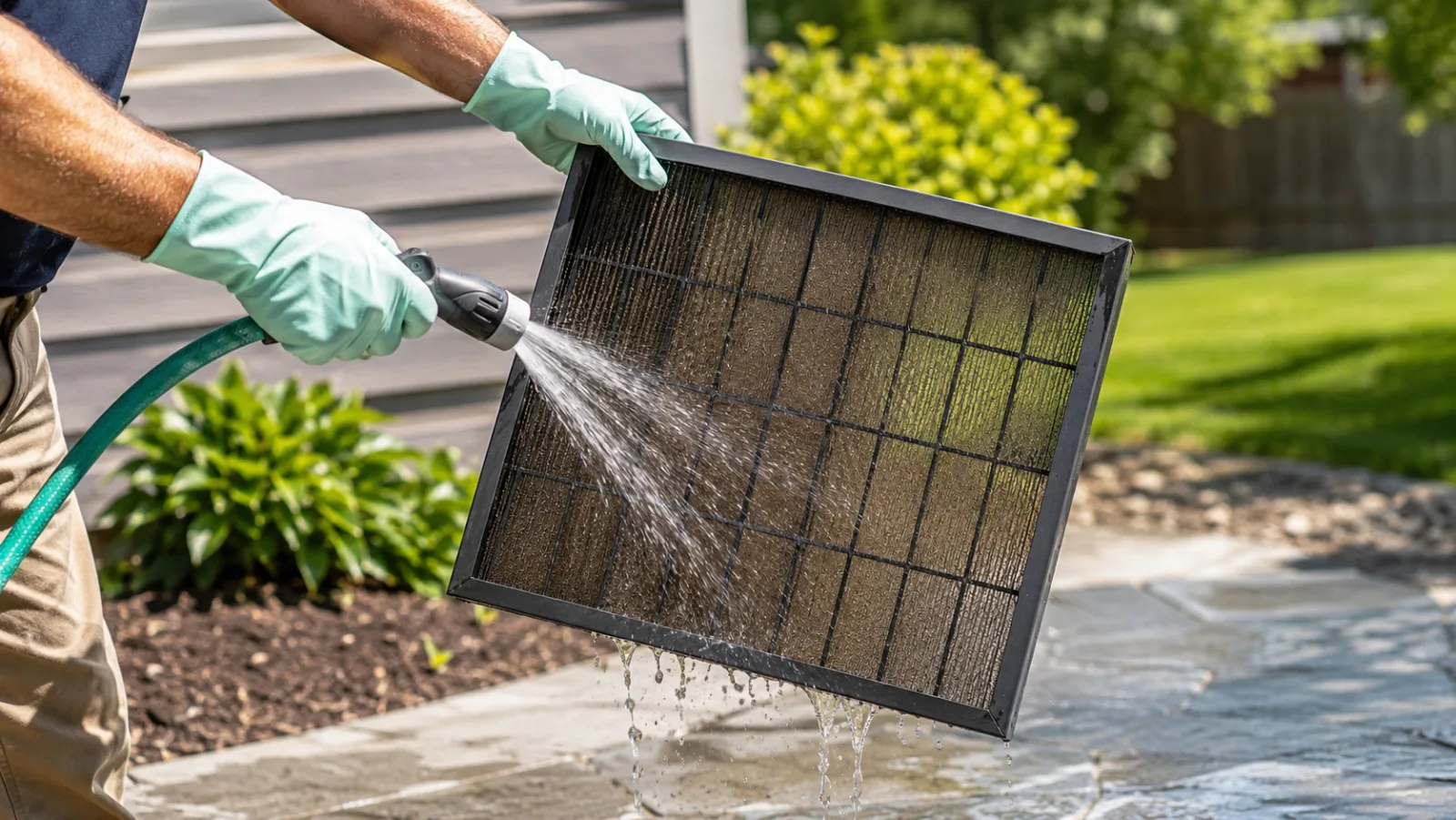
Cleaning a washable filter is straightforward when you follow the steps in order. The sequence below protects both the filter and your system.
- Shut down the HVAC system at the thermostat and breaker.
- Locate and remove the permanent filter, noting the airflow arrow.
- Flush with water from the clean side (opposite the airflow arrow).
- Apply mild dish soap or a 50/50 vinegar solution, then rinse thoroughly with clean water.
- Allow the filter to air-dry completely (up to 24 hours) before reinstalling it.
Step 1: Shut Down the HVAC System
Turn the system off at the thermostat and switch off the furnace breaker before you touch the filter. This is a safety step, not an optional one. With the blower stopped, the loose dust dislodged during removal cannot get pulled into the air handler and spread through your ducts.
Step 2: Locate and Remove the Permanent Filter
Find the filter slot, usually in the return-air duct or inside the air-handler cabinet near the blower. Slide the filter out gently. Before it leaves your hand, find the printed airflow arrow on the frame and note which way it points, since you will need that direction for both rinsing and reinstalling.
Step 3: Flush the Filter with Water (The Correct Direction)
Rinse the filter with a garden hose or faucet, spraying against the airflow arrow, the opposite of the direction air normally travels. Air flows in through the arrow side, so the dirt is packed on that face. Spraying from the clean side pushes the trapped debris back out the way it came in, instead of driving it deeper into the media. Use steady, low-to-moderate pressure so you clear the dirt without bending the frame.
Step 4: Use Mild Dish Soap or a Vinegar Solution
For a filter with odor or greasy buildup, wash it with a little mild dish soap or a 50/50 white-vinegar-and-water solution. Vinegar answers a common question, yes you can use vinegar on a washable filter, because the mild acid naturally neutralizes the odor-causing bacteria that collect in the media. Work the solution in gently, then rinse until the water runs clear so no residue remains.
Step 5: Air-Dry Completely Before Reinstallation
Stand the filter on a towel and let it air-dry completely before it goes back in, several hours, and up to 24 hours in humid weather. This step is not optional. A damp filter slid into a dark duct grows mold within days, and the system then blows those spores through your home. Once the filter is bone-dry, reinstall it with the airflow arrow pointing toward the furnace, and restore power.
How to Clean a Furnace Humidifier Filter with Vinegar
A furnace humidifier filter is a different part with a different rule, and this is where many guides get it wrong. The pad that most whole-house humidifiers use, called a water panel or evaporator pad, is a disposable, coated component. Manufacturers such as Aprilaire and Honeywell recommend replacing that pad each heating season (or every one to three months in hard water), not soaking it, because vinegar and scrubbing break down its coating.
Vinegar cleaning belongs to the reusable parts, not the pad. Soak the metal and plastic components that collect mineral scale, the scale-control insert, the distribution tray, the frame, and the metal mesh of older drum-style humidifiers, in a 50/50 white-vinegar-and-water solution for 20 to 30 minutes. The mild acid dissolves the calcium and lime deposits naturally. Then rinse the parts, drop in a fresh water panel, and reassemble. In short: descale the hardware with vinegar, and replace the pad.
Long-Term Maintenance: How Often to Clean Your Furnace Filter?
Clean a washable furnace filter every one to three months, closer to every 30 days in a home with pets, heavy dust, or wildfire smoke in the air. A filter checked on that schedule protects both your air and your equipment.
The filter is only one part of a larger system, though. While the standard rule of thumb is every one to three months for the filter, tracking how often to clean your furnace filter alongside the whole heating system keeps your home’s indoor air quality clean year-round.
Frequently Asked Questions
What can I use instead of mild dish soap to clean a permanent filter?
Use a 50/50 mix of white vinegar and warm water. The mild acid cuts through odor-causing bacteria and light grease without leaving a soapy residue. Soak or spray the filter, rinse it until the water runs clear, and let it dry completely before reinstalling.
How do I know if my reusable furnace filter is damaged and needs replacement?
Look for a warped or cracked frame, tears or holes in the electrostatic mesh, and odors that linger even after a thorough wash. Any of these means the filter no longer seals or filters correctly, and a damaged filter lets dust bypass it straight into your system.
Can I clean my furnace system myself?
You can handle the filter yourself; washing a permanent filter is an ideal DIY task. The internal mechanical components are a different matter. The burners, heat exchanger, blower, and ductwork require professional evaluation, which our furnace duct cleaning service provides safely.