Dryer Vent Cleaning Frequency and Maintenance Guide
How often to clean a dryer vent by household type, why it prevents fires, the warning signs of a clogged vent, and the limits of DIY cleaning. SoCal Green, LA.

A dryer vent is the exhaust line that carries hot, moist air and lint from a clothes dryer to the outside of a building, and that vent requires professional cleaning at least once per year. Lint accumulates inside the exhaust line with every load, restricts airflow, and creates a fire hazard.
This guide states the exact cleaning frequency for each household type, explains why the maintenance cycle prevents fires, identifies the warning signs of a clogged vent, and defines the limits of DIY cleaning.
How Often Should Dryer Vents Be Cleaned?
Dryer vents require professional cleaning at least once per year to maintain appliance efficiency and prevent residential house fires. Households with large families, pets, or high daily laundry usage require cleaning every six months.
The National Fire Protection Association sets the annual standard for typical household use. Lint buildup drives the schedule. Every drying load sheds fibers, the lint screen captures only a portion of those fibers, and the remainder settles inside the exhaust line. That lint restricts airflow, forces the dryer to run longer cycle times, and raises the temperature inside the duct. Heat, flammable lint, and restricted ventilation combine into a fire hazard.
| Household type | Cleaning frequency |
|---|---|
| Typical household | Once per year |
| Large family or daily laundry (10+ loads weekly) | Every six months |
| Households with shedding pets | Every six months |
| Long or vertical exhaust runs | Once per year minimum |
| Condominium and multi-family units | Once per year, or per HOA bylaws |
| Commercial and short-term rental properties | Every three to six months |
Pet hair accelerates the accumulation rate. Pet dander and fur bypass the lint screen, adhere to the damp interior walls of the exhaust line, and form dense, felt-like blockages. A household with shedding pets such as dogs, cats, or rabbits therefore cuts the cleaning interval in half.
How Often Should Clothes Dryer Vents Be Cleaned in a Condo?
Condo dryer vents require cleaning once a year, or more frequently if mandated by homeowners association (HOA) bylaws. Because condo exhaust lines span longer distances and traverse multiple firewalls, they accumulate lint faster than single-family home vents.
A multi-family building routes dryer exhaust differently than a house does. Vertical exhaust ducts carry lint upward against gravity toward a roof termination, and lint drops out of the airstream across those long runs. Many buildings install inline booster fans inside the vertical duct to maintain airflow. A booster fan caked in lint stalls, the exhaust air backs up down the riser, and the blockage affects neighboring units on the same stack.
HOA guidelines and fire code govern the schedule. The International Mechanical Code, Section 504, sets the requirements for clothes dryer exhaust, and local fire officials enforce those requirements in multi-family buildings. A condo’s CC&Rs and bylaws assign responsibility: the unit owner maintains the appliance, the lint screen, and the in-unit transition hose, and the HOA maintains the shared risers and the exterior terminations. A unit owner reads the governing documents to confirm the division, because the bylaws override any general guideline.
Is Dryer Vent Cleaning Necessary?
Yes, dryer vent cleaning is a critical safety and efficiency maintenance task. Restricted exhaust vents force dryers to run hotter and longer, which damages clothes, increases utility bills, and creates a significant risk of lint ignition.
Fire authorities agree on the cause. The National Fire Protection Association states in its Clothes Dryer Safety Tip Sheet that the leading cause of home clothes dryer fires is failure to clean them. The U.S. Fire Administration reaches the same conclusion and identifies failure to clean as the leading factor contributing to the ignition of clothes dryer fires. Both agencies rank this single maintenance failure ahead of every mechanical and electrical cause.
Lint drives that ignition. Lint is a highly combustible material, lint accumulates inside both the dryer and the exhaust line, and accumulated lint reduces airflow. A compromised vent fails to exhaust properly, which overheats the appliance and ignites the trapped lint. A gas dryer carries added risk, because NFPA reports the fire risk runs slightly higher for gas-fueled dryers than for electric-powered dryers.
Cleaning also restores efficiency. A clear exhaust line releases moisture quickly, which shortens cycle times and lowers the electricity or gas the dryer consumes. Professional dryer vent cleaning removes the lint and returns the appliance to its designed performance.
What Are the Signs Your Dryer Vent Needs Cleaning?
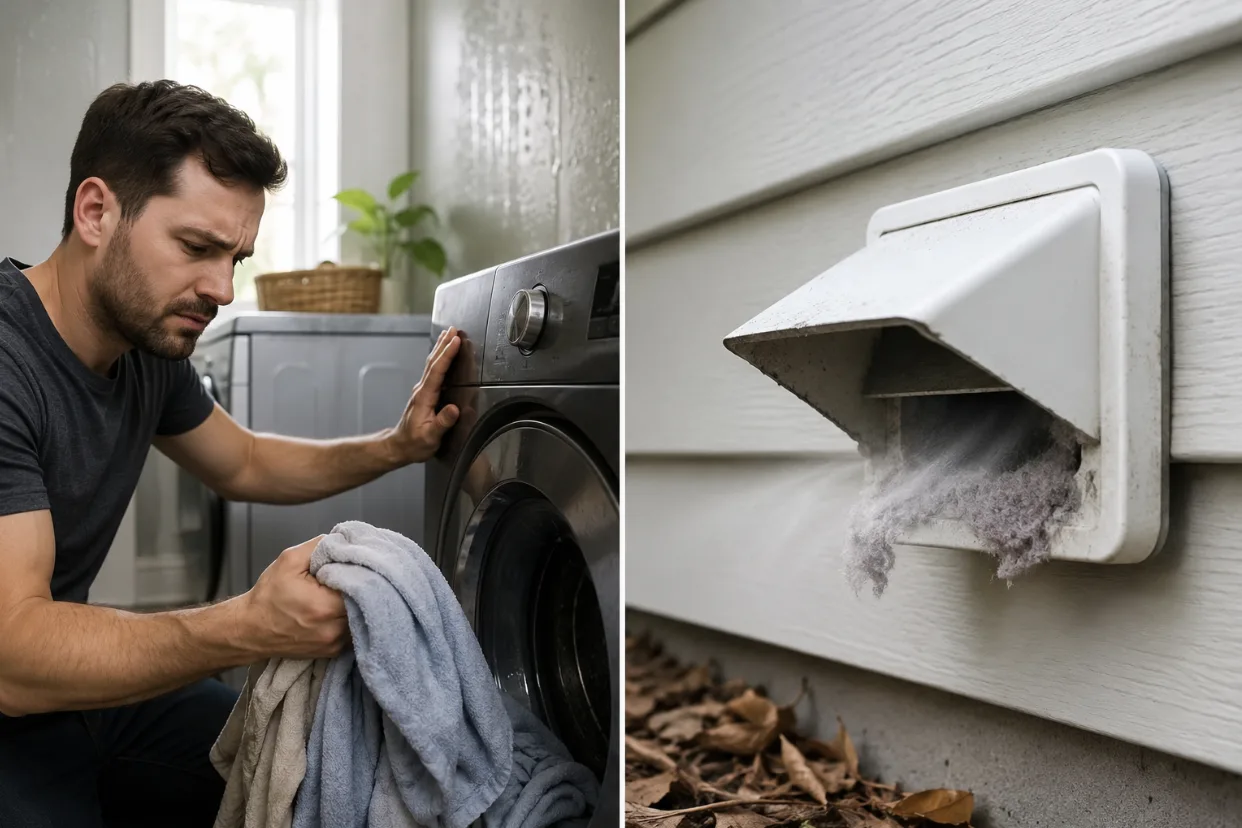
Clear indicators of a clogged dryer vent include drying cycles exceeding 50 minutes, an unusually hot dryer exterior, a musty burning smell in the laundry room, and a lack of visible exhaust coming from the exterior vent hood.
A homeowner inspects for these specific signs:
- Long drying cycles. A load that requires two cycles, or a single cycle exceeding 50 minutes, signals restricted airflow.
- Damp clothes at cycle end. Trapped moisture leaves fabrics such as towels, jeans, and sheets wet after a full cycle.
- A hot dryer exterior. Heat that escapes into the cabinet instead of the exhaust line makes the appliance and the clothes hot to the touch.
- A burning or musty smell. Scorched lint produces a burning odor, and trapped moisture produces a musty odor.
- A closed exterior vent flap. The vent hood flap stays shut during a cycle, which proves that exhaust air fails to reach the outside.
- Laundry room humidity. Moisture that backs up into the room raises humidity and grows mold on surfaces such as walls and baseboards.
- Visible lint at the vent hood. Lint gathers around the exterior opening.
Any one of these signs triggers an immediate inspection, regardless of the last service date.
Can You Clean a Dryer Vent Yourself?
Homeowners clean short, straight dryer vents using a DIY rotary brush kit attached to a power drill. However, complex, long, or vertical duct runs require professional high-powered vacuum and compressed air systems to prevent duct damage or compacting the lint.
A DIY kit contains flexible rods and a brush head with a drill attachment. The rods extend through the duct, and the rotating brush dislodges surface lint. This method clears a short, straight run that terminates on a nearby exterior wall.
The method fails on complex systems, and the failure carries consequences:
- Compacted lint blockage. Pushing lint without vacuum extraction packs the debris into a dense plug, which NADCA identifies as a hidden blockage that creates a fire risk.
- Duct damage. Rods separate inside the duct, and brushes tear flexible transition hose, which creates leaks that release lint into wall cavities.
- Incomplete removal. A brush reaches a limited distance, and the lint beyond that distance remains.
A professional service uses vacuum extraction and compressed-air tools that clear the entire exhaust line from the appliance to the exterior termination, then verifies the airflow at the vent hood. A vertical condo riser, a roof termination, or a run with multiple bends requires that equipment.
How Long Does Dryer Vent Cleaning Take?
A standard professional dryer vent cleaning takes between 30 to 60 minutes. Factors that extend the cleaning time up to two hours include roof-vent access, multi-story routing, heavily impacted clogs, or rigid duct repairs.
Four factors determine the service duration:
| Factor | Effect on duration |
|---|---|
| Access points | A roof termination requires ladder setup and adds time |
| Vertical ducting | Multi-story routing extends brush transit time |
| Clog severity | A heavily impacted lint plug requires repeated passes |
| Duct repairs | Damaged or non-compliant duct requires replacement work |
Brush transit time explains the range. A technician drives the brush the full developed length of the exhaust line, and a 30-foot condo riser demands more transit time than a 10-foot wall termination. A homeowner shortens the appointment by clearing access: move the dryer’s surrounding items, clear shelves above the appliance, and secure pets in a separate room.
Many homeowners combine services in one visit. A dryer vent cleaning pairs with an air duct cleaning, because both services clean the exhaust and supply pathways of the same home.
SoCal Green’s certified technicians clean the full exhaust line, verify the airflow, and quote the price upfront. Explore the complete dryer vent services or schedule a cleaning today.
Ready to book? Call (888) 280-2285 or book a professional dryer vent cleaning.
Frequently Asked Questions
How often should a dryer vent be cleaned?
A dryer vent requires professional cleaning at least once per year. Households with large families, shedding pets, or more than ten laundry loads per week require cleaning every six months. The National Fire Protection Association sets the annual standard, and warning signs such as long drying cycles override the schedule.
Why is dryer vent cleaning important?
Dryer vent cleaning removes the lint that causes the leading cause of dryer fires. Restricted exhaust forces the dryer to run hotter and longer, which damages components such as the thermal fuse and heating element, raises utility bills, and backs carbon monoxide into homes with gas dryers.
What are the signs of a clogged dryer vent?
The signs include drying cycles exceeding 50 minutes, damp clothes at cycle end, a hot dryer exterior, a burning or musty smell, a closed exterior vent flap during operation, and rising laundry room humidity. Any single sign triggers an immediate inspection.
Can I clean my dryer vent myself?
A homeowner cleans a short, straight vent with a rotary brush kit and a power drill. Long runs, vertical risers, and roof terminations require professional vacuum extraction and compressed air. DIY methods on complex ducts compact the lint into a hidden blockage and damage the duct walls.
How long does dryer vent cleaning take?
A standard professional dryer vent cleaning takes 30 to 60 minutes. Roof-vent access, multi-story routing, heavily impacted clogs, and rigid duct repairs extend the service up to two hours. Clearing access around the appliance shortens the appointment.
How often should condo dryer vents be cleaned?
Condo dryer vents require cleaning once per year, or more frequently when HOA bylaws mandate a shorter interval. Condo exhaust lines run longer, travel vertically, and traverse firewalls, so lint accumulates faster. The CC&Rs assign responsibility between the unit owner and the association.